|
Spot power prices rebounded from the previous week in both East Japan (50Hz) and West Japan (60Hz) during Oct 12-16. In East Japan, prices rose during both daytime and nighttime hours, while in West Japan, daytime prices softened but nighttime prices increased. As more thermal power plants were taken offline for scheduled maintenance and other reasons, supply-demand conditions tightened from the evening onward, when solar power generation declined, providing support to prices.
By area, prices in Tokyo and Chubu remained elevated. Reduced supply capacity due to outages at large thermal power plants was a major bullish factor, with prices rising particularly during evening hours. In Tokyo, prices reached a high of Yen 47.02/kWh on the evening of Oct 13. Meanwhile, prices in Kansai increased from the previous week but remained relatively subdued compared with Tokyo and Chubu. In Hokkaido, localized price spikes to around Yen 50/kWh seen in the previous week subsided, and the weekly average price fell from the previous week.
On Oct 16, JEPX announced the results of its baseload power auction for delivery in fiscal 2027. The clearing price in Tokyo was Yen 18.03/kWh, with a contracted volume of 89 MW, while Kansai recorded Yen 13.10/kWh and 233.5 MW. The results attracted considerable attention, as the first auction had been canceled and prices for fiscal 2027 contracts in the futures market had continued to surge. However, some market participants viewed the results as reasonable. "Considering the current market environment, the price levels are reasonable," said a representative of a new power supplier.
The difference in the 24-hour average spot electricity prices between Tokyo and Kansai, the major areas in East and West Japan, stood at Yen 9.85/kWh on Oct 12, Yen 9.21 on Oct 13, Yen 6.89 on Oct 14, Yen 7.86 on Oct 15 and Yen 5.01 on Oct 16, with Tokyo prices exceeding Kansai prices throughout the week.
Fuel market developments in the third week of October were as follows.
Spot LNG prices in the Northeast Asian market stood in the low $29s/mmBtu on Oct 16 for cargoes delivered in Dec 2026, up by around $3/mmBtu from the previous weekend (Oct 9). Prices surged in the first half of the week amid growing concerns over LNG supply disruptions due to escalating tensions in the Middle East. On Oct 14, prices climbed to the low $30s/mmBtu, the highest level since Dec 2022.
However, prices retreated in the latter half of the week, weighed down by weaker European natural gas prices and increased spot LNG supplies in the Northeast Asian market. While buyers in China and South Korea showed interest in procuring cargoes ahead of the winter demand season, Japanese buyers remained largely reluctant to make spot purchases.
Japan's LNG inventories for power generation stood at 2.64 million mt as of Oct 11, up 70,000 mt from 2.57 million mt in the previous week. Domestic inventories remained at elevated levels, indicating that Japan's LNG supply-demand balance continued to be relatively comfortable.
Australian thermal coal prices on a FOB Newcastle basis stood at $150.40/mt on Oct 16 for the Oct 2026 contract, up $1.55/mt from $148.85/mt on the previous weekend (Oct 9).
Prices reached $150.40/mt on Oct 13 before edging down to $150.35/mt on Oct 14 and $149.65/mt on Oct 15. However, prices rebounded above $150/mt on Oct 16.
With spot LNG prices remaining elevated, market participants may have focused on the price competitiveness of coal as a power generation fuel. Nevertheless, price movements were relatively limited throughout the week, with little aggressive buying interest at higher levels.
Crude oil prices rose sharply during the week ended Oct 16. WTI crude oil futures for Nov 2026 delivery settled at $101.41/bbl on Oct 16, while Brent crude oil futures for Dec 2026 delivery stood at $109.86/bbl. Compared with the previous weekend (Oct 9), WTI rose by $9.56/bbl and Brent gained $5.14/bbl.
Concerns over crude oil supply intensified from the first half of the week amid escalating tensions in the Middle East. In the latter half of the week, reports of possible attacks on oil-related facilities in Saudi Arabia and attacks on Russian refineries provided further upward pressure on prices.
Brent briefly reached $110/bbl on Oct 16, as buying driven by supply disruption concerns dominated the market.
The highest spot price during the week was Yen 50.01/kWh, recorded in Hokkaido on Oct 9. Meanwhile, the lowest spot price was Yen 0.01/kWh, recorded in Chugoku through Kyushu on Oct 6, Hokkaido and Tohoku on Oct 7, Hokkaido, Tohoku, and Chugoku through Kyushu on Oct 8, and Tohoku on Oct 9.
The highest spot electricity price during the week was Yen 47.02/kWh, recorded in three areas of East Japan on Oct 13.
Meanwhile, the lowest spot price was Yen 0.01/kWh, recorded in Chugoku, Shikoku and Kyushu on Oct 14; Hokkaido, Tohoku, Chugoku, Shikoku and Kyushu on Oct 15; and Shikoku on Oct 16.
The weekly averages of 24-hour spot prices, traded volumes, and buy and sell bid volumes by area were as follows.
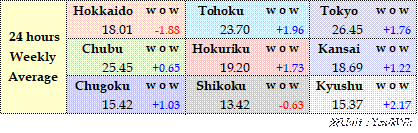

Power demand in Japan's nine areas totaled 10.391143 GWh during Oct 12-16, down 1.2% from 10.515886 GWh in the previous week (Oct 5-9). Compared with 10.700617 GWh recorded during the corresponding five weekdays of the previous year (Oct 13-17), demand declined by 2.9%.
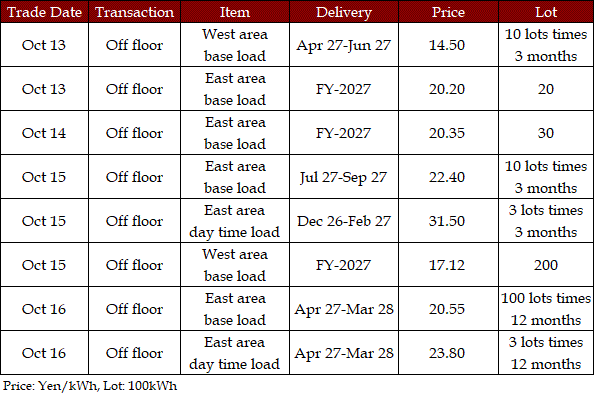
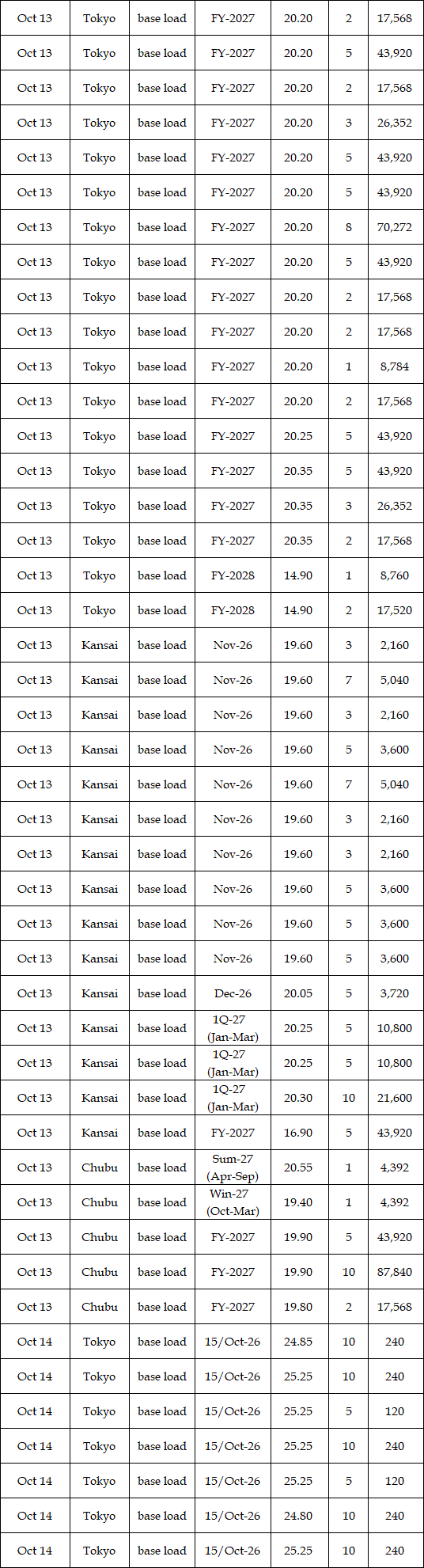
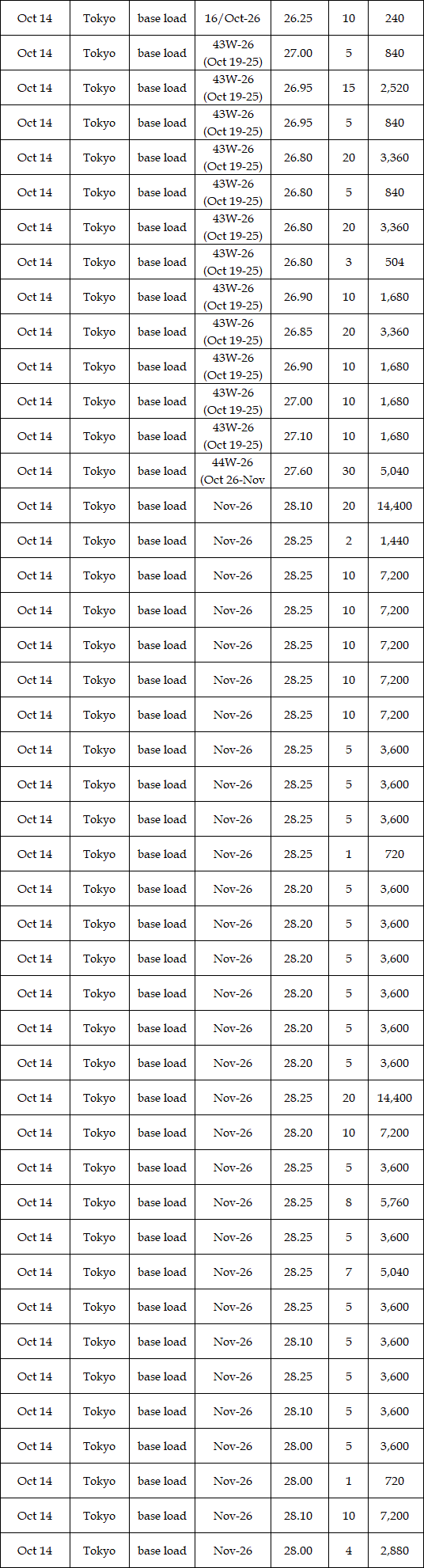
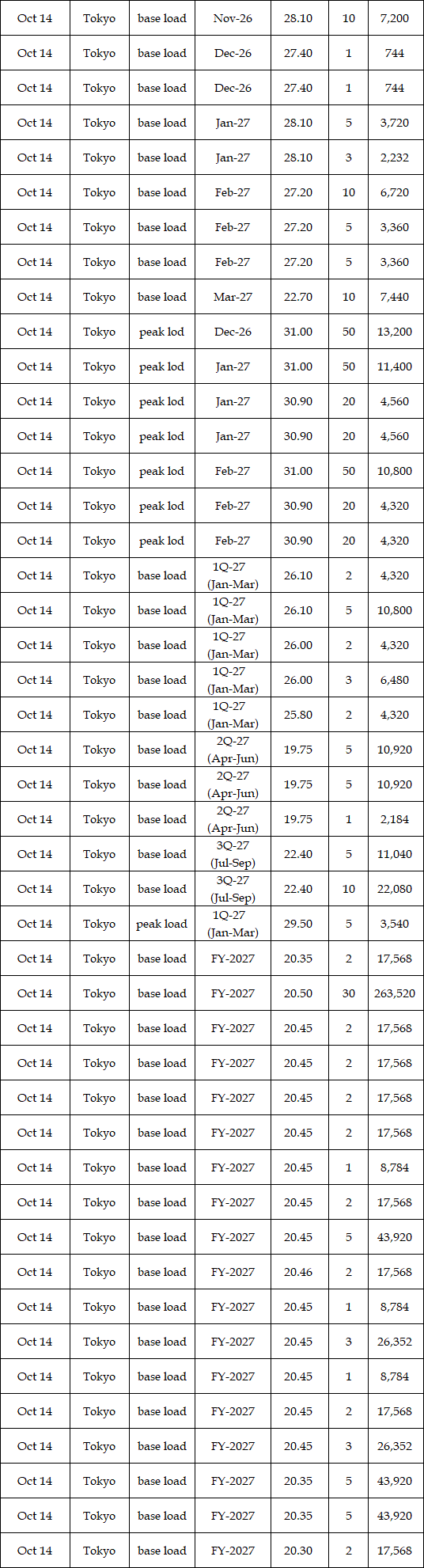
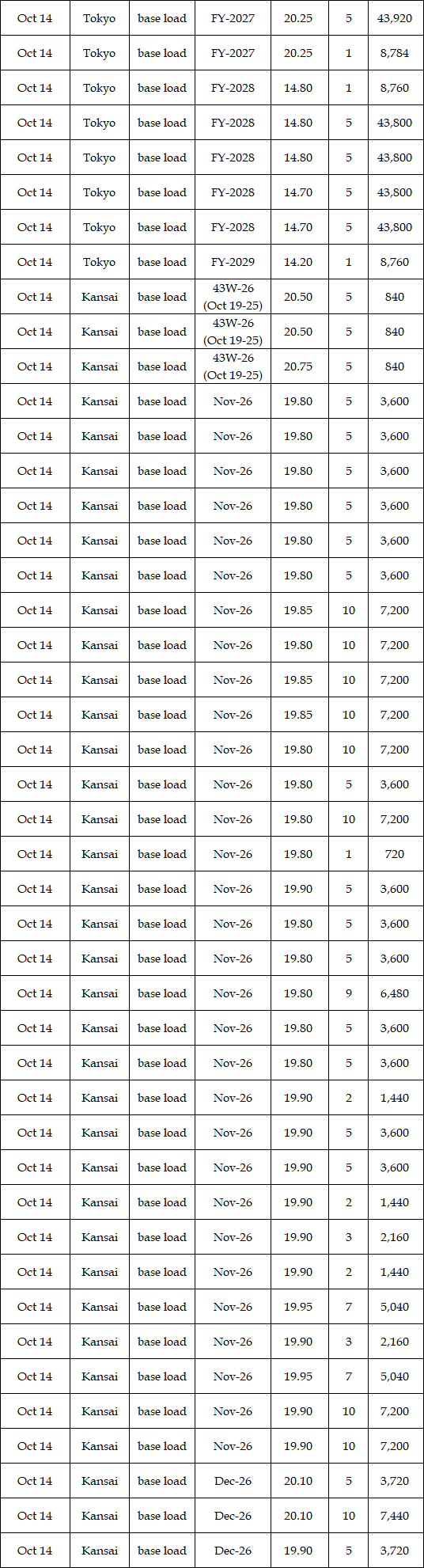
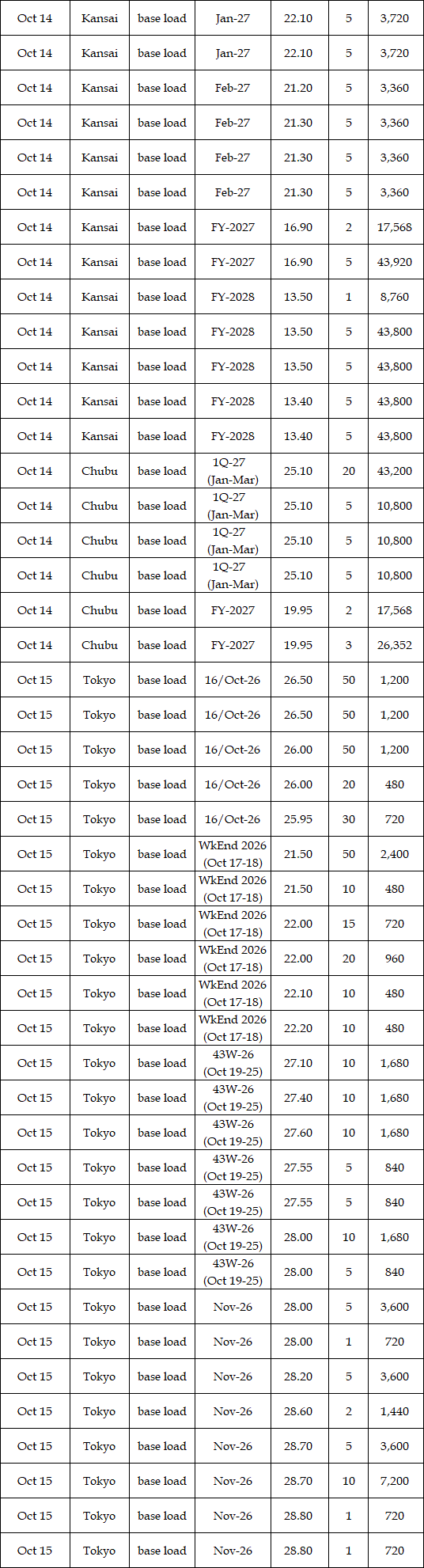
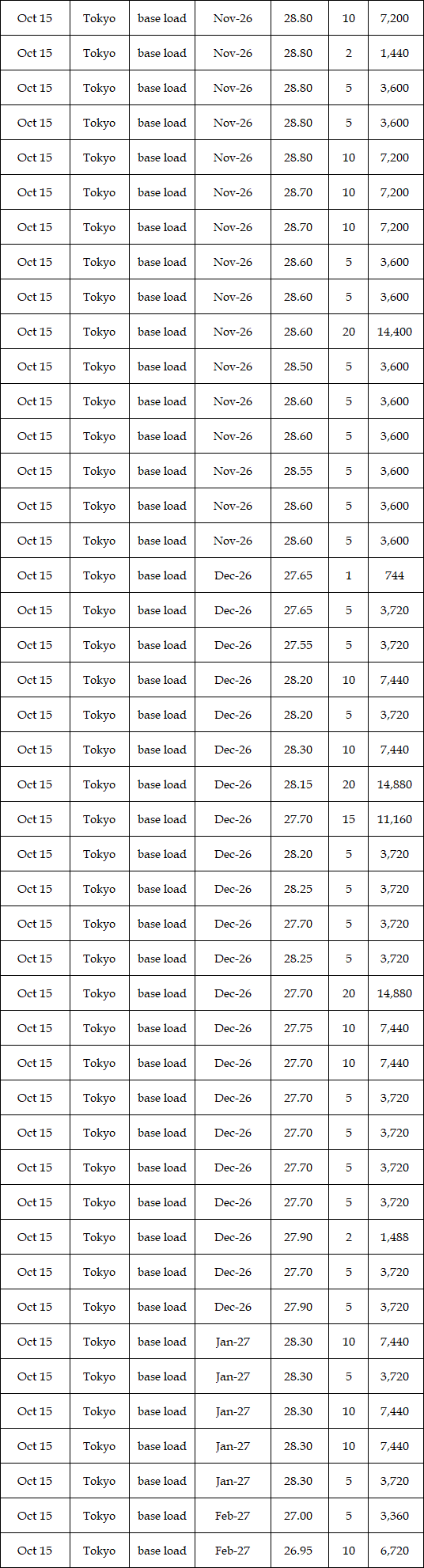
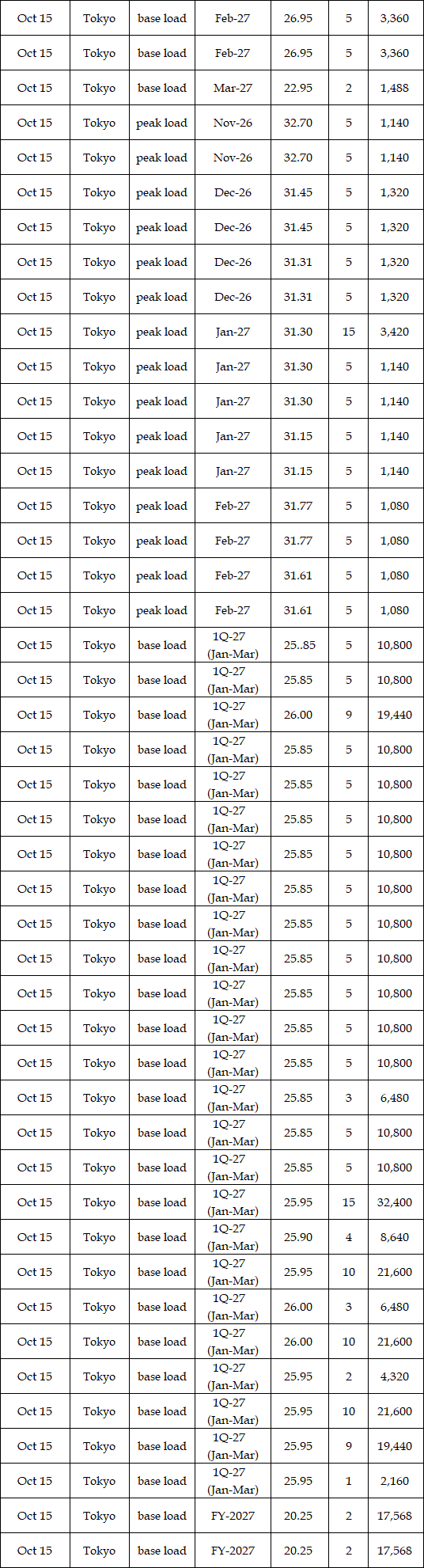
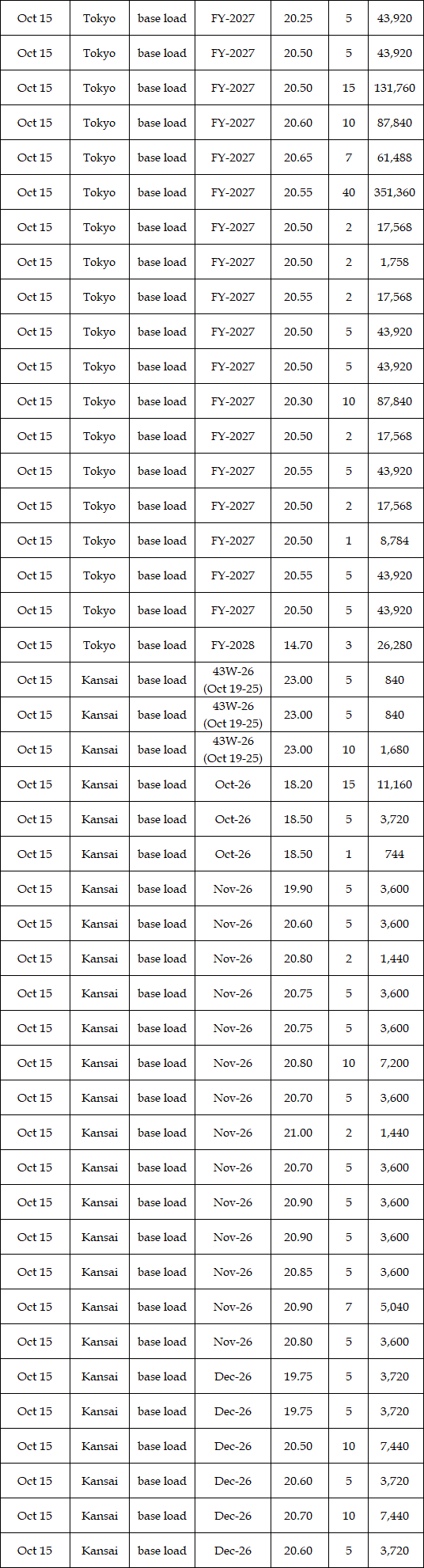
Deals reported on TOCOM (Tokyo Commodity Exchange) during Oct 12-16 were as below.
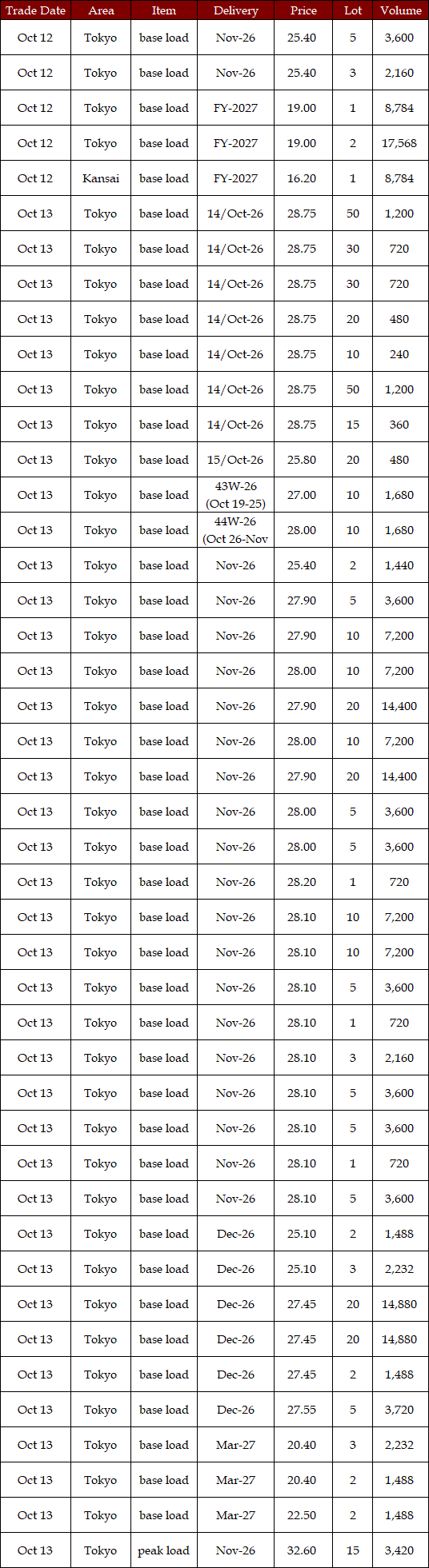
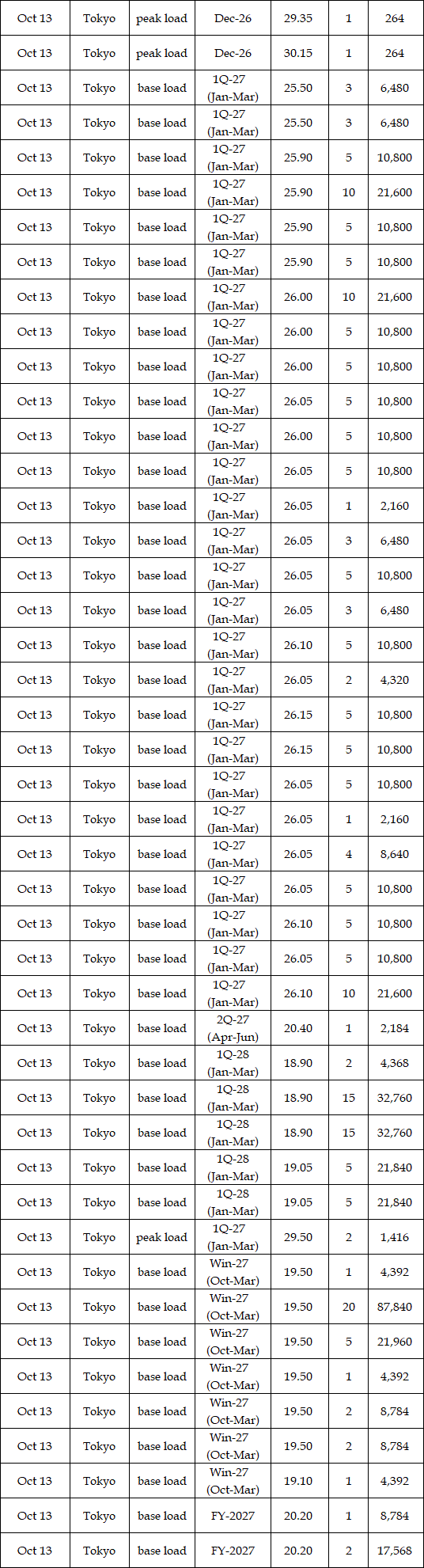
Deals reported on EEX (European Energy Exchange) during Oct 12-16 were as below.
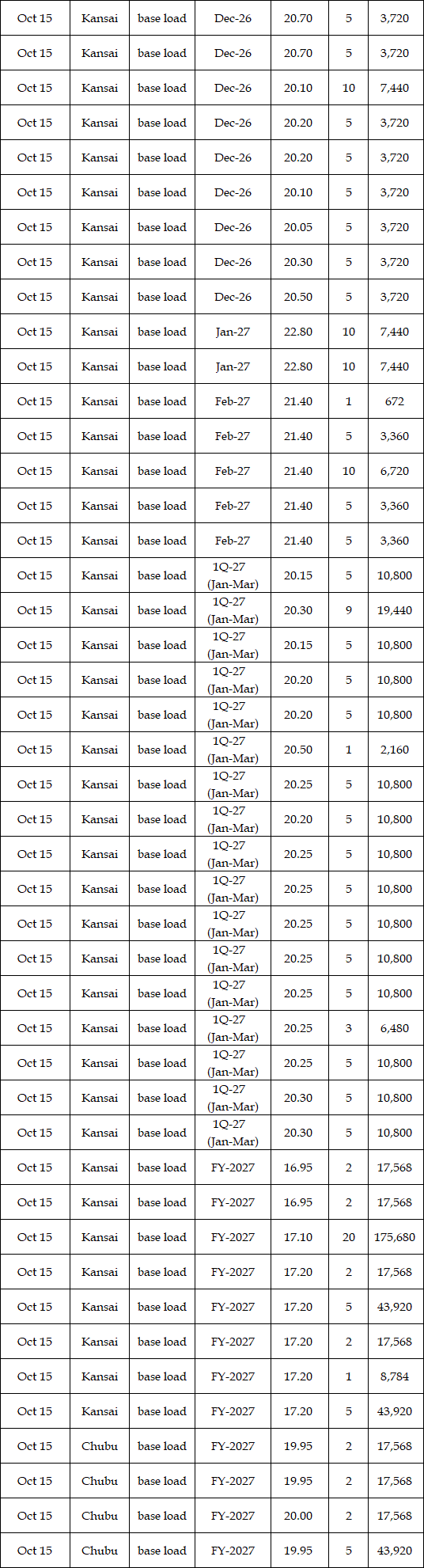
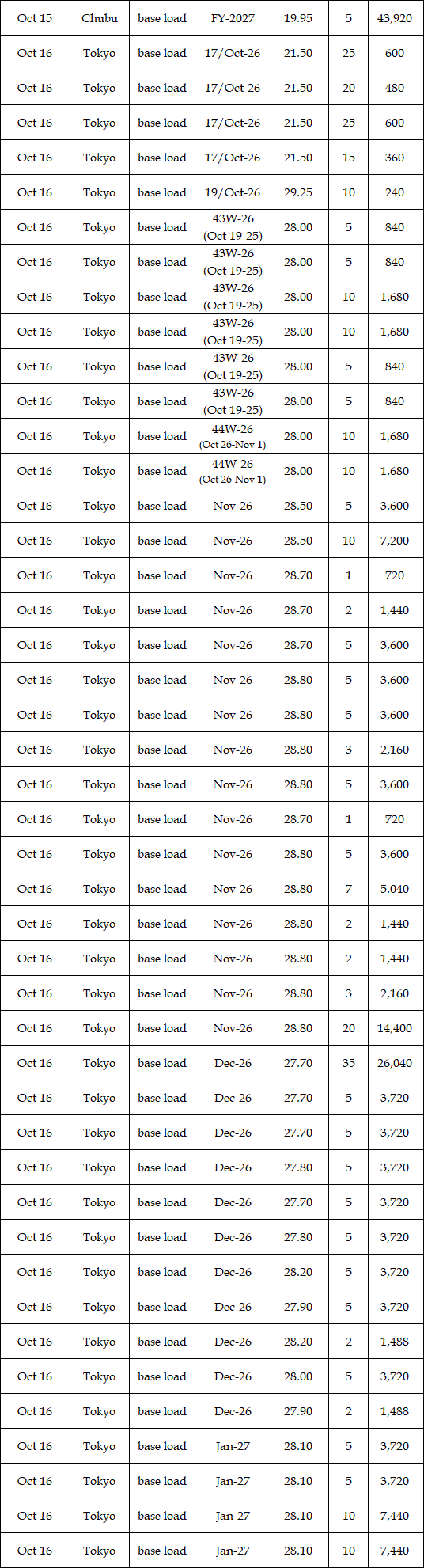
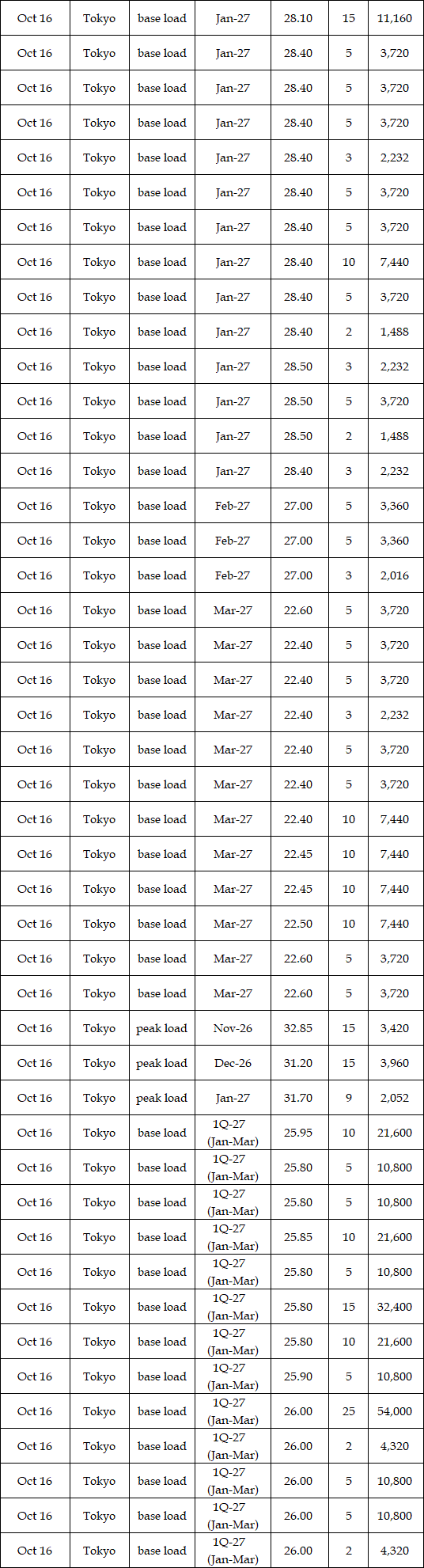
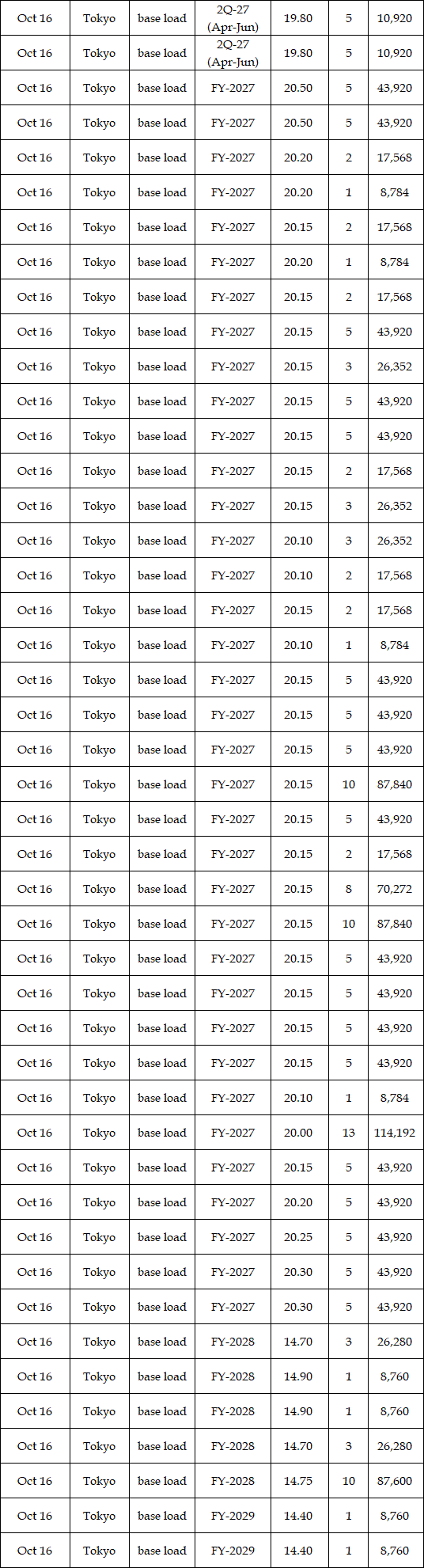
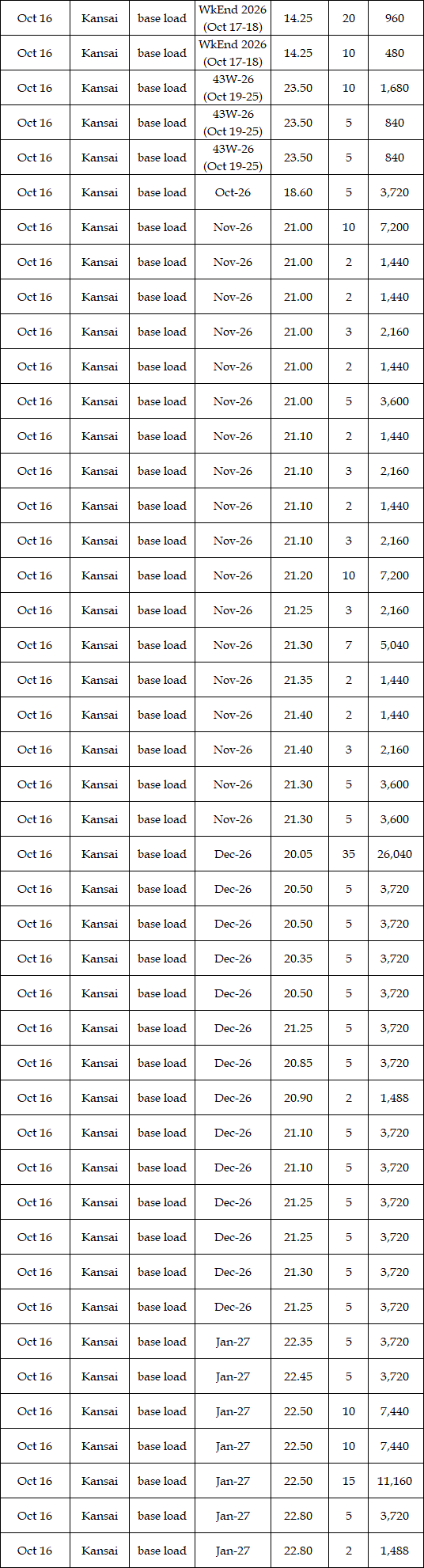
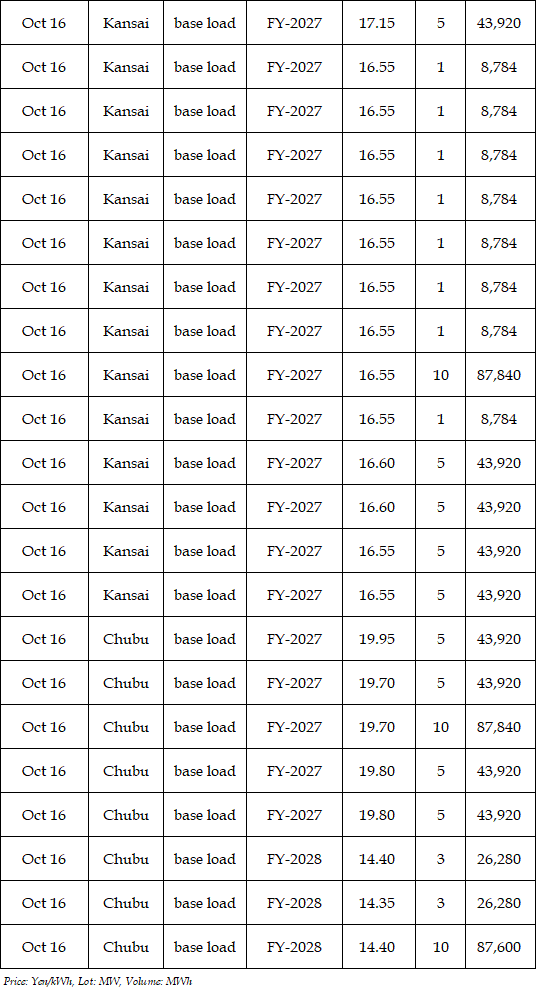
Spot electricity prices are expected to remain elevated in the fourth week of Oct, particularly in Tokyo and Chubu. With large thermal power plants remaining offline in both areas, prices could rise into the Yen 30s/kWh or to around Yen 40/kWh, especially during evening hours when solar power generation declines.
In the first half of the week, solar radiation conditions are expected to differ between East and West Japan. In the Kanto region, although cloudy conditions are expected during Oct 19-21, some periods of sunshine should help maintain a certain level of solar power generation. Meanwhile, cloudy and rainy weather in the Tokai and Kinki regions is expected to limit solar power output, making daytime prices less likely to decline. In Chubu in particular, where several large thermal power plants are offline, reduced solar power generation could lead to higher prices.
In the latter half of the week, weather conditions are expected to improve mainly in Tohoku and Tokai. Increased solar power generation could put downward pressure on daytime prices. However, residual demand is expected to increase in the evening as solar power output declines, leaving prices in Tokyo and Chubu prone to spikes.
In Kansai, Unit 1 at the Himeji No. 2 LNG-fired power plant, with a rated capacity of 486,500 kW, is scheduled to be taken offline from Oct 19. Market participants will be watching for changes in available supply capacity. In West Japan, unsettled weather is expected from the first half through the middle of the week. Reduced solar power generation could push daytime prices above the previous week's levels.
In Hokkaido, spot electricity prices are expected to be influenced by the operating status of thermal power plants within the area as well as constraints on interconnection facilities with Honshu. In Tohoku, cloudy and rainy conditions in the first half of the week are also expected to reduce solar power generation, potentially pushing up daytime prices.
Regarding the price outlook for the fourth week of Oct, one market participant said, "We expect prices to average around Yen 24-29/kWh in Tokyo, Yen 25-30/kWh in Chubu and Yen 19-24/kWh in Kansai," according to a power trading official at a new power supplier.
|
JEPX: System Price (Day Ahead 24 hours)
|
|
Weekday Price
|
12-Oct
|
13-Oct
|
14-Oct
|
15-Oct
|
16-Oct
|
|
24-Hour Ave
|
20.57
|
24.66
|
24.24
|
21.38
|
21.61
|
|
Volume (MWh)
|
869,002
|
998,515
|
1,041,517
|
1,014,593
|
1,010,288
|
|
(unit: yen per kWh) (date: delivery day)
|
|
|

|
 - Fair & Reliable -

 Post
 Print


