|
Spot power prices in both East Japan (50Hz) and West Japan (60Hz) continued to rise during Oct 19-23 from the previous week. With outages at major thermal power plants overlapping, supply-demand conditions tightened particularly in the evening hours when solar power generation declined, pushing up prices. Price increases were particularly pronounced in West Japan, mainly in Kansai.
By area, prices in Tokyo and Chubu remained at high levels. In Tokyo, the daily average price reached Yen 33.29/kWh on Oct 20. In Kansai, supply-demand conditions tightened on Oct 21 amid outages at major thermal power plants, including the 700-MW No. 2 coal-fired unit at Kobe Power Plant operated by Kobelco Power Kobe. The Organization for Cross-regional Coordination of Transmission Operators (OCCTO) subsequently instructed cross-regional power transfers to ease the tight supply-demand balance. Meanwhile, Hokkaido recorded an exceptionally high price of Yen 105.00/kWh on Oct 20. In contrast, Shikoku saw prices as low as Yen 0.01/kWh on several occasions, mainly during daytime hours, and was the only one of the nine areas to post a week-on-week decline in its weekly average price.
The spreads between the 24-hour average spot electricity prices in Tokyo and Kansai, the major areas in East and West Japan, stood at Yen 2.06/kWh on Oct 19, Yen 3.08/kWh on Oct 20, Yen 3.04/kWh on Oct 21, Yen 3.42/kWh on Oct 22 and Yen 2.23/kWh on Oct 23, with Tokyo consistently higher than Kansai.
Fuel market developments in the fourth week of October were as follows.
Spot LNG prices in the Northeast Asian market for December 2026 delivery stood in the low $31s/mmBtu on Oct 23, up about $2 from the previous weekend (Oct 16). Prices hovered in the low $30s early in the week before softening to the mid-$29s on Oct 21. However, prices rebounded in the latter half of the week, reaching $31.30 on Oct 23, the highest level since December 2022. Supply concerns stemming from escalating tensions in the Middle East continued to support the market. Japan's LNG inventories for power generation stood at 2.54 million mt as of Oct 18, down 100,000 mt from 2.64 million mt a week earlier. However, inventories remained at high levels, exceeding both the 1.87 million mt recorded at the end of October last year and the five-year average of 2.10 million mt.
Australian Newcastle thermal coal futures for October 2026 stood at $150.70/mt on Oct 23, up $0.30 from $150.40 on the previous weekend (Oct 16). Prices edged lower early in the week, reaching $150.55 on Oct 21, before rebounding to $151.15 on Oct 22. Prices then softened again to $150.70 on Oct 23. With spot LNG prices remaining at high levels, coal's price competitiveness as a fuel for power generation may have attracted attention. However, price fluctuations remained relatively small throughout the week, with the market showing no clear direction.
In the crude oil market, WTI futures for December 2026 stood at $103.27/bbl on Oct 23, while Brent futures for December 2026 were at $116.72/bbl. WTI rose by $4.25 and Brent by $6.86 from the previous weekend (Oct 16). Prices struggled to gain ground early in the week but surged in the latter half amid escalating tensions in the Middle East. Concerns over disruptions to crude oil supplies intensified following attacks on Saudi Arabian energy-related facilities and other targets by the Houthis, an Iran-aligned armed group in Yemen. An oil spill off the coast of the United Arab Emirates and concerns over maritime transportation around the Strait of Hormuz also prompted buying. On Oct 23, WTI jumped by $3.80 from the previous day, while Brent surged by $3.55, with both benchmarks posting sharp gains.
The highest spot price during the week was Yen 50.01/kWh, recorded in Hokkaido on Oct 9. Meanwhile, the lowest spot price was Yen 0.01/kWh, recorded in Chugoku through Kyushu on Oct 6, Hokkaido and Tohoku on Oct 7, Hokkaido, Tohoku, and Chugoku through Kyushu on Oct 8, and Tohoku on Oct 9.
The highest spot price during the week was Yen 105.00/kWh, recorded in Hokkaido on Oct 20. Meanwhile, the lowest spot price was Yen 0.01/kWh, recorded in Shikoku on Oct 21, in Hokkaido, Tohoku, Chugoku, Shikoku and Kyushu on Oct 22, and in Shikoku on Oct 23.
The weekly averages of 24-hour spot prices, traded volumes, and buy and sell bid volumes by area were as follows.
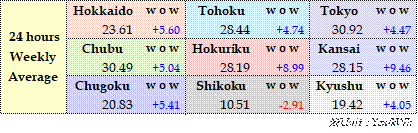

Power demand in the nine areas during Oct 19-23 totaled 10.797082 billion kWh, up 3.9% from 10.391143 billion kWh in the previous week (Oct 12-16). Compared with 10.494088 billion kWh recorded during Oct 20-24 last year, adjusted for the same days of the week, demand increased by 2.9%.
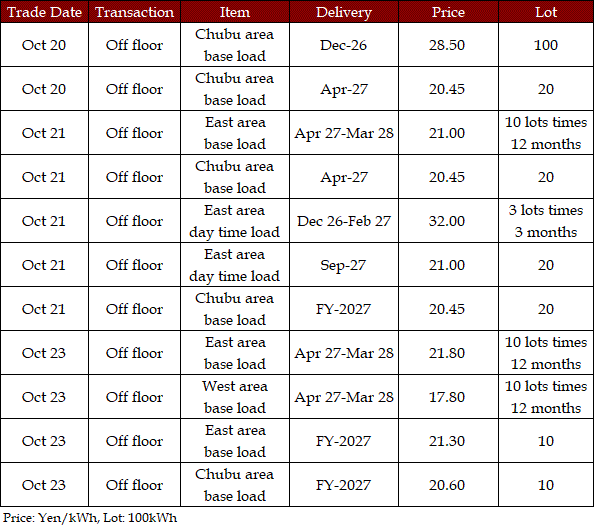
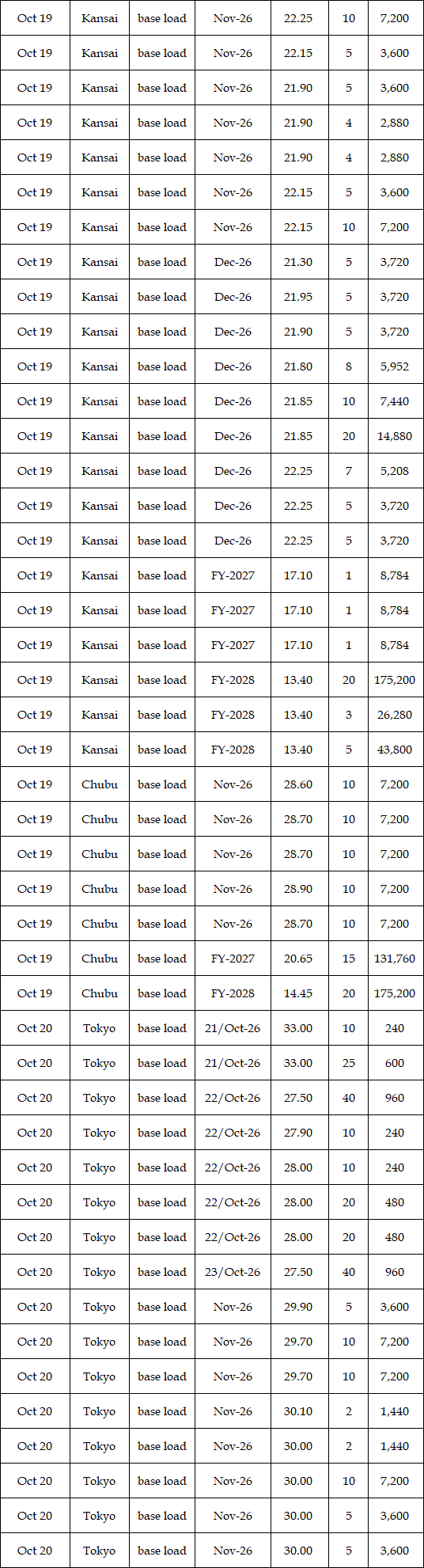
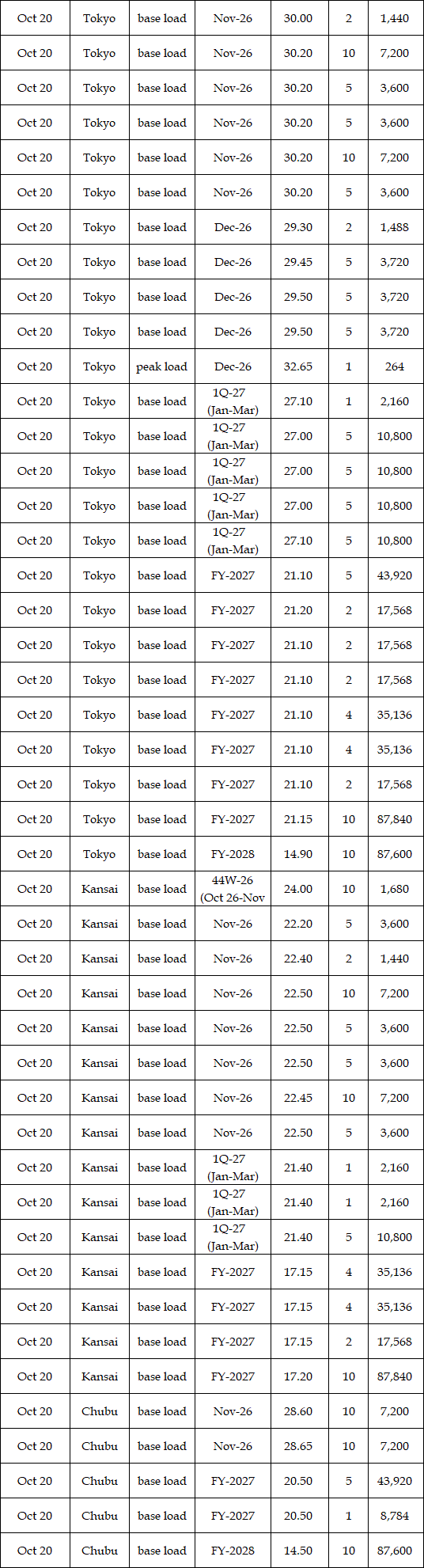
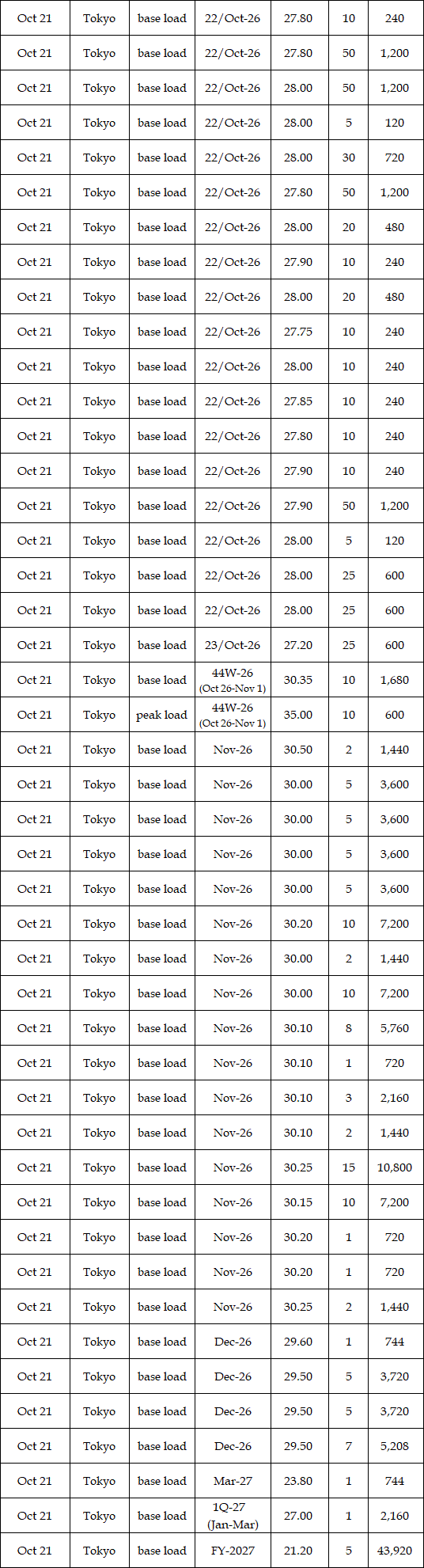
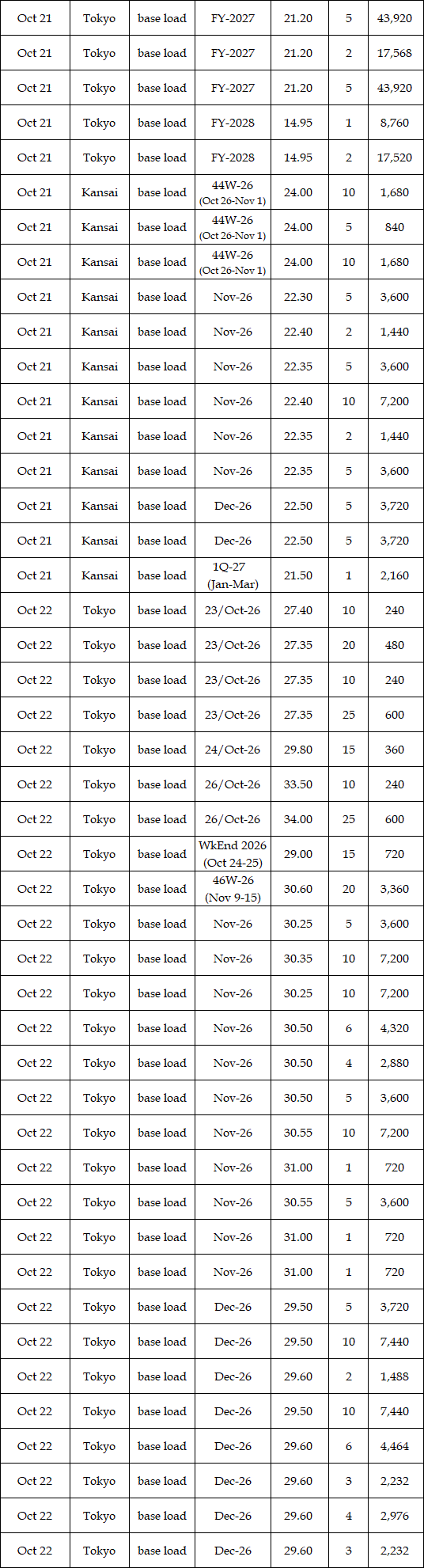
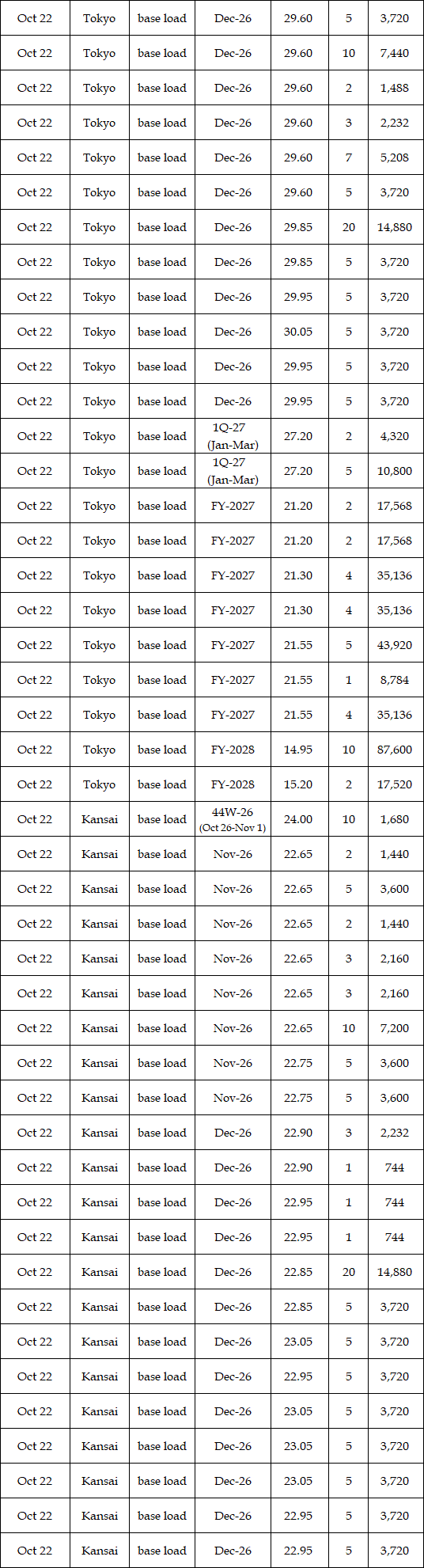
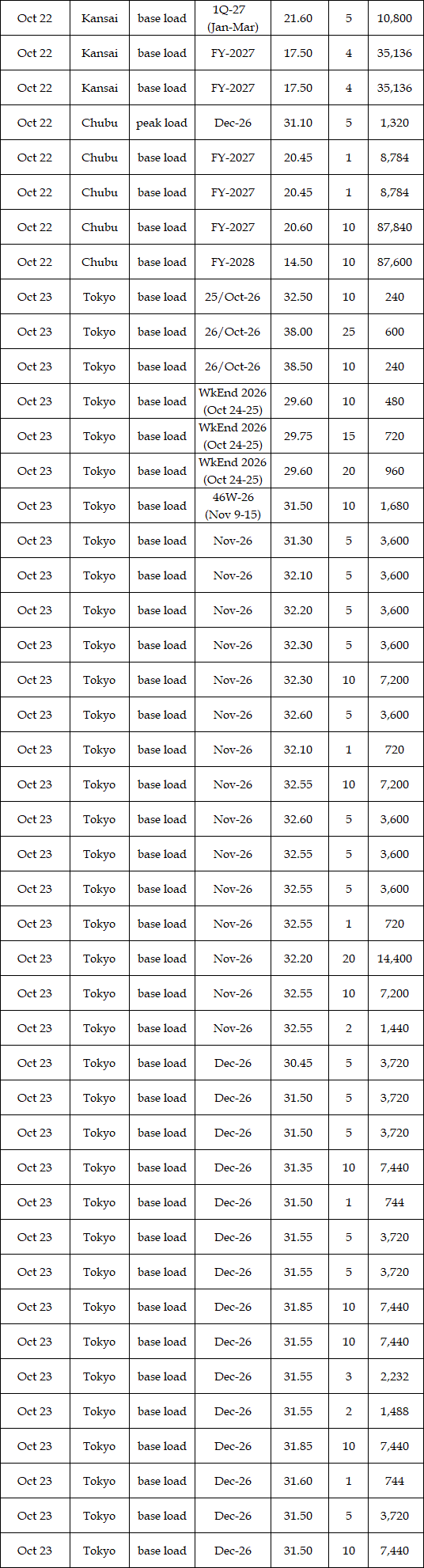
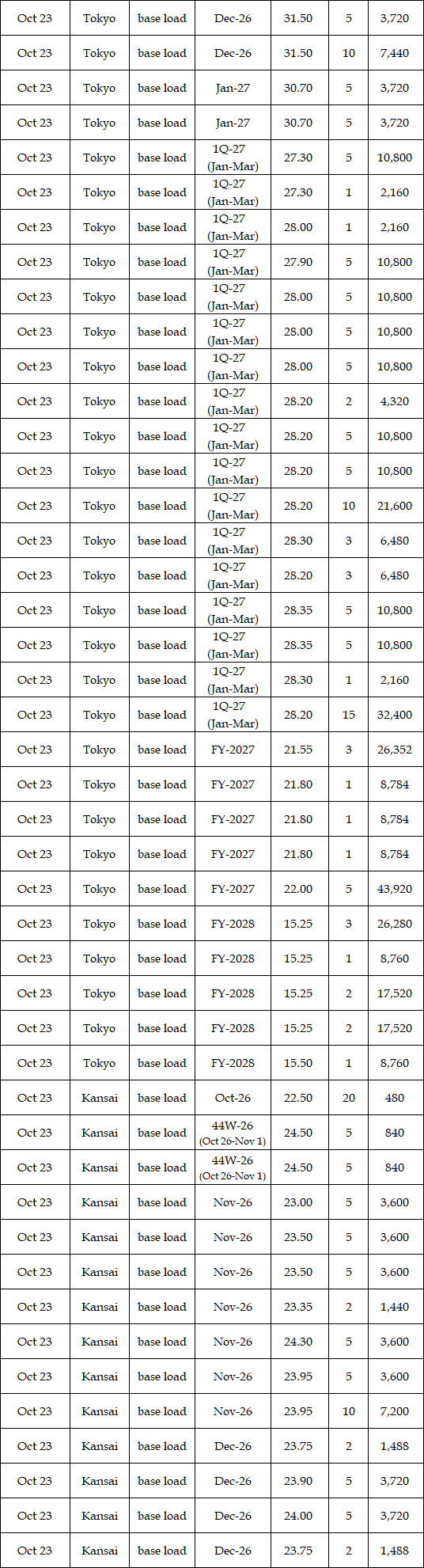
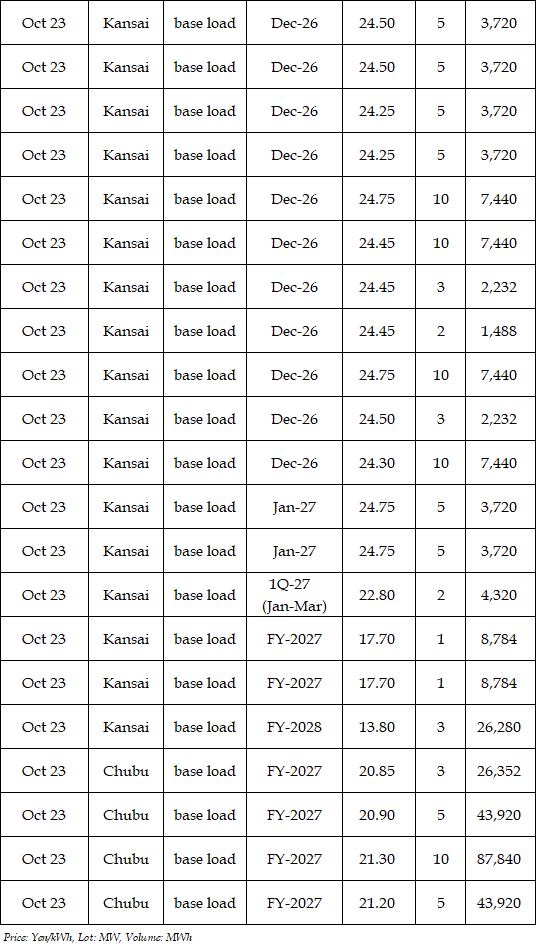
Deals reported on TOCOM (Tokyo Commodity Exchange) during Oct 19-23 were as below.
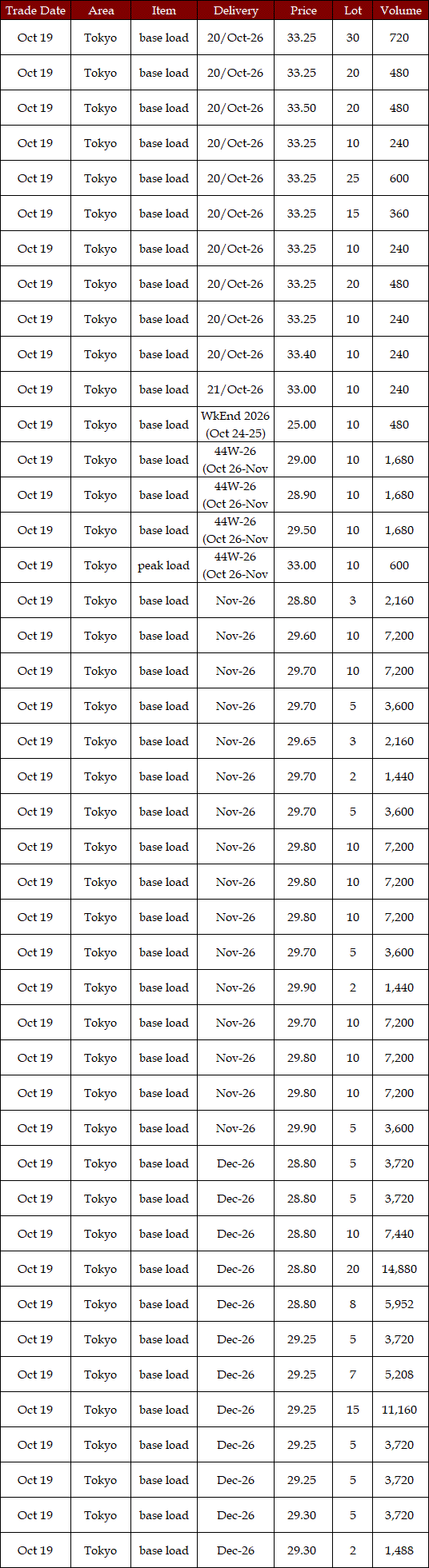
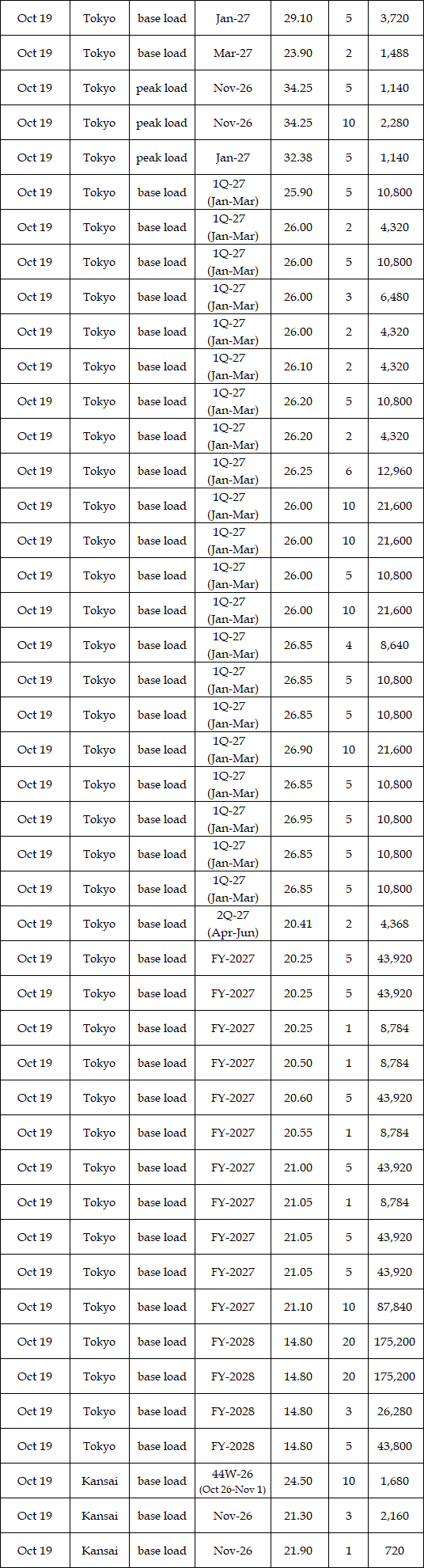
Deals reported on EEX (European Energy Exchange) during Oct 19-23 were as below.
Spot electricity prices are expected to remain at high levels in the final week of October, particularly in Tokyo and Chubu. Outages at major thermal power plants are continuing in both areas, limiting available supply capacity. Prices could rise further, especially in the evening hours when solar power generation declines. In particular, worsening solar power generation conditions are expected early in the week, potentially leading to high prices even during daytime hours.
Cloudy and rainy weather is forecast in the Kanto region on Oct 26-27, potentially limiting solar power generation. In Tokyo and Chubu, where outages at thermal power plants are overlapping, available supply capacity during the daytime is expected to remain limited, raising concerns over a further tightening of supply-demand conditions toward the evening. Meanwhile, improving weather conditions from Oct 28 onward could boost solar power generation, putting downward pressure on daytime prices. However, price spreads between daytime and evening hours could widen as solar power generation declines toward the evening.
On the supply side, the No. 1 and No. 2 units at Hitachinaka Thermal Power Plant in the Tokyo area and the No. 2 and No. 4 units at Hekinan Thermal Power Plant in the Chubu area are expected to remain offline. In Chubu, the No. 7-1 unit at Nishi-Nagoya Thermal Power Plant is scheduled to resume operations on Oct 30, but supply constraints are expected to persist for most of the week. Depending on the progress of restarts at thermal power plants, evening prices could fluctuate significantly.
Outages at thermal power plants are also continuing in West Japan, and prices could rise depending on weather and demand conditions. Meanwhile, Shikoku showed price movements that differed from those in other areas this week. Price spreads between Shikoku and neighboring areas could widen again next week, depending on solar power generation and the operating conditions of interconnection lines.
Overall, prices are expected to remain firm early in the week, particularly in Tokyo and Chubu, amid limited solar power generation and continuing outages at thermal power plants. Although daytime prices could soften later in the week due to improving weather conditions and the restart of some thermal power units, available supply capacity during the evening hours is expected to remain limited. In particular, high prices could emerge in Tokyo and Chubu as supply-demand conditions tighten.
|
JEPX: System Price (Day Ahead 24 hours)
|
|
Weekday Price
|
19-Oct
|
20-Oct
|
21-Oct
|
22-Oct
|
23-Oct
|
|
24-Hour Ave
|
29.90
|
31.15
|
31.13
|
22.41
|
25.34
|
|
Volume (MWh)
|
1,000,760
|
1,098,083
|
1,144,117
|
1,070,042
|
1,027,792
|
|
(unit: yen per kWh) (date: delivery day)
|
|
|

|
 - Fair & Reliable -

 Post
 Print


