|
Power spot prices in eastern Japan (50Hz) rose for the second consecutive week during Oct 26-30, while prices in western Japan (60Hz) declined except in Shikoku. Prices in Tokyo and Chubu remained elevated, with particularly high prices recorded in the evening hours when solar power output decreased. Meanwhile, prices in Kansai retreated as the upward pressure caused by tight supply-demand conditions in the previous week eased. Prices also softened in Chugoku and Kyushu. In addition, market price separation between areas had a significant impact on price movements.
By area, Tokyo recorded the highest weekly average price among the nine areas, with its daily average exceeding Yen 35.00 on Oct 26. Prices in Chubu also remained in the Yen 30s, highlighting the strength of the market, particularly in eastern Japan. Meanwhile, prices in Kansai declined from the previous week, although prices in the Yen 30s persisted during the evening hours. In Hokkaido, prices reached Yen 50.00 on Oct 26, while prices as low as Yen 0.01 were occasionally observed during daytime hours in Shikoku.
The differences in the 24-hour average spot prices between Tokyo and Kansai, the major areas in eastern and western Japan, stood at Yen 8.71 on Oct 26, Yen 8.58 on Oct 27, Yen 7.13 on Oct 28, Yen 5.62 on Oct 29 and Yen 3.92 on Oct 30, with Tokyo consistently higher than Kansai. The price gap was particularly wide in the first half of the week but narrowed toward the latter half.
Fuel market developments in the final week of October were as follows.
In the Northeast Asian LNG spot market, the price for Dec 2026 delivery stood in the mid-$32s/mmBtu on Oct 30, up more than $1 from the previous weekend (Oct 23). Supply concerns stemming from heightened tensions in the Middle East supported prices. Japan's LNG inventories for power generation stood at 2.15 million mt as of Oct 25, down 380,000 mt from 2.53 million mt in the previous week. However, inventories remained above both the 1.87 million mt recorded at the end of Oct last year and the five-year average of 2.10 million mt.
In the Australian Newcastle thermal coal market, the Nov 2026 contract stood at $152.45/mt on Oct 30, down $2.55 from the previous weekend (Oct 23). Although the price competitiveness of coal as a power generation fuel attracted attention amid elevated LNG spot prices, thermal coal prices fluctuated throughout the week and weakened overall.
In the crude oil market, WTI futures for Dec 2026 stood at $104.12/bbl on Oct 30, while Brent futures for Dec 2026 were at $117.64/bbl. WTI rose $0.85 and Brent gained $0.92 from the previous weekend (Oct 23), both posting modest increases. Prices faced resistance in the first half of the week amid expectations for a diplomatic resolution to tensions in the Middle East but rebounded toward the weekend. Concerns over potential disruptions to crude oil supplies intensified following attacks on tankers in the Strait of Hormuz and fears of attacks on energy facilities in Saudi Arabia. On Oct 30, WTI surged $2.12 from the previous day, while Brent jumped $2.76, both posting sharp gains.
The highest actual transaction price during the week was Yen 50.00, recorded in Hokkaido on Oct 26. Meanwhile, the lowest actual transaction price was Yen 0.01, recorded in Shikoku on Oct 27 and in Chugoku, Shikoku and Kyushu on Oct 28.
The highest spot price during the week was Yen 105.00/kWh, recorded in Hokkaido on Oct 20. Meanwhile, the lowest spot price was Yen 0.01/kWh, recorded in Shikoku on Oct 21, in Hokkaido, Tohoku, Chugoku, Shikoku and Kyushu on Oct 22, and in Shikoku on Oct 23.
The weekly averages of 24-hour spot prices, traded volumes, and buy and sell bid volumes by area were as follows.
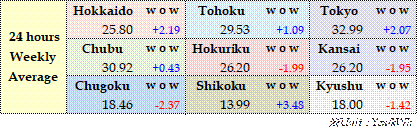

Power demand across the nine areas during Oct 26-30 totaled 10,512.728 GWh, down 2.6% from 10,797.082 GWh during the previous week of Oct 19-23. Compared with 10,565.792 GWh recorded during the corresponding weekdays of Oct 27-31 last year, demand declined 0.5%.
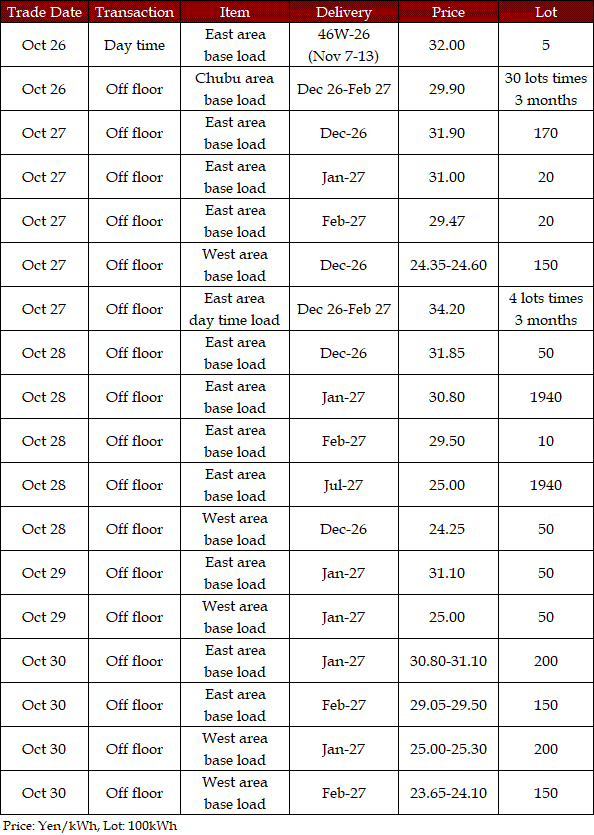
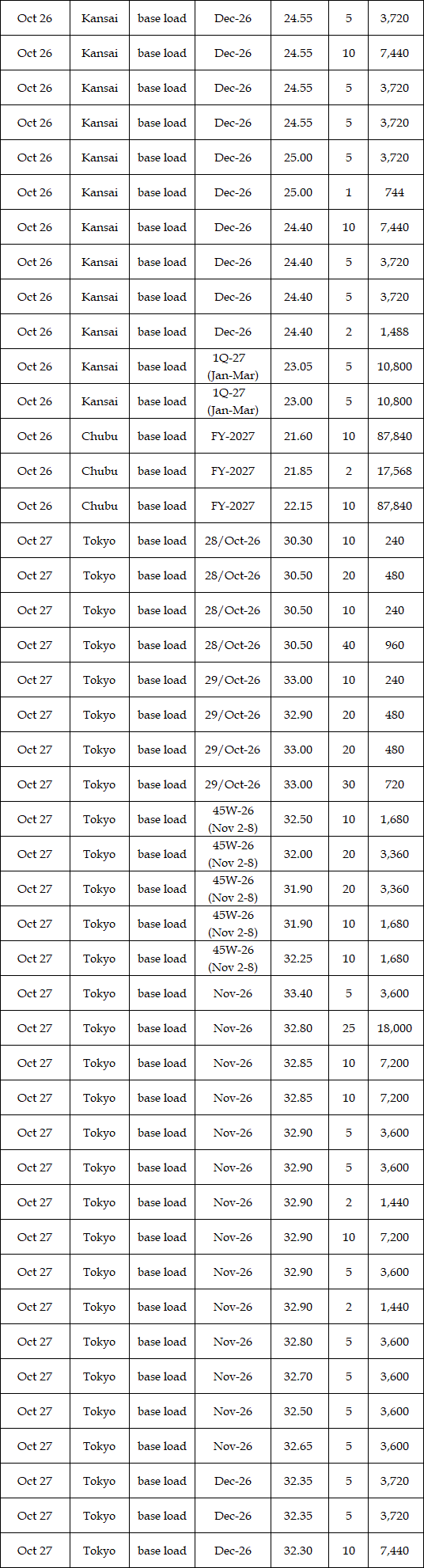
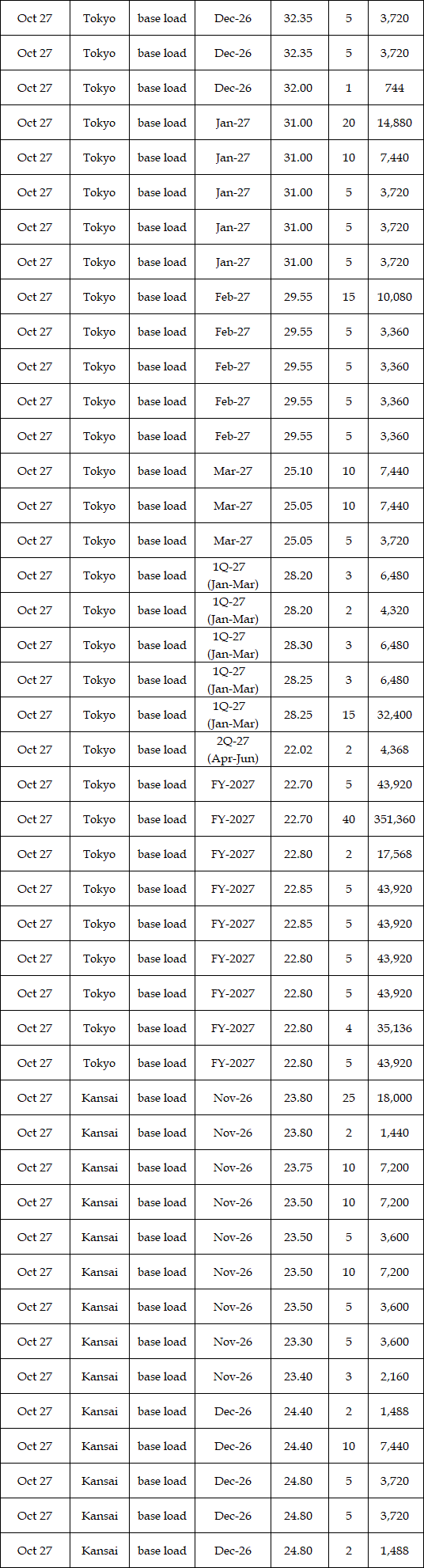
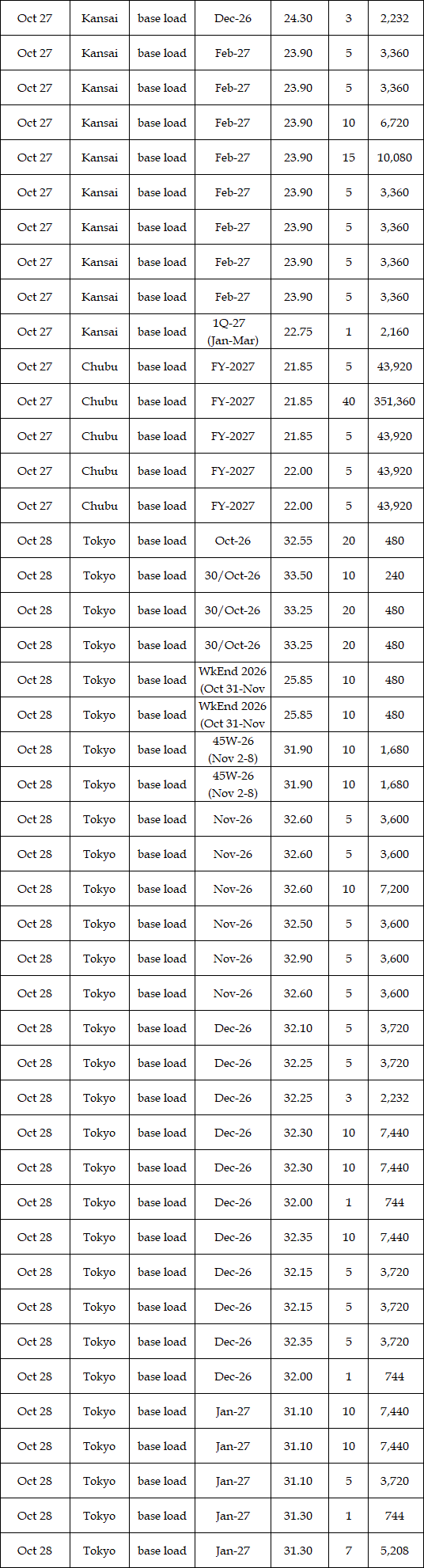
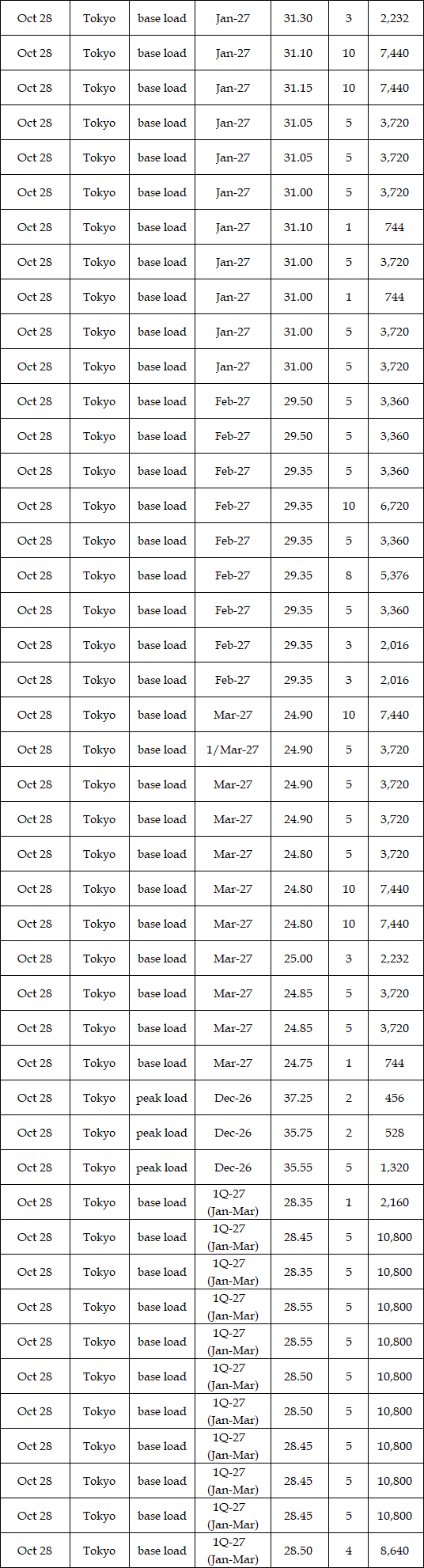
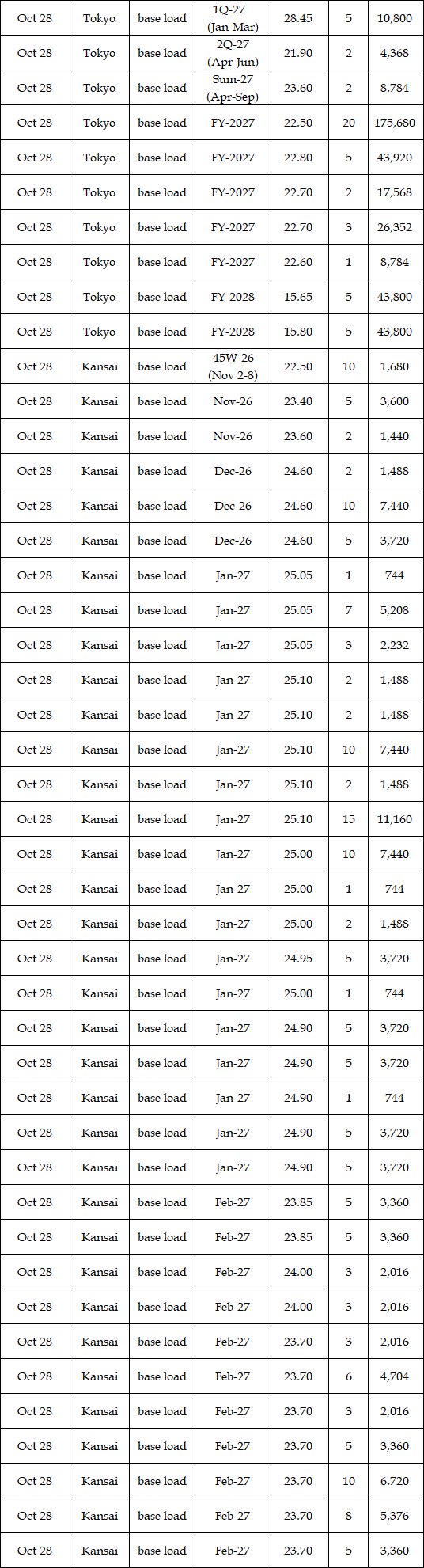
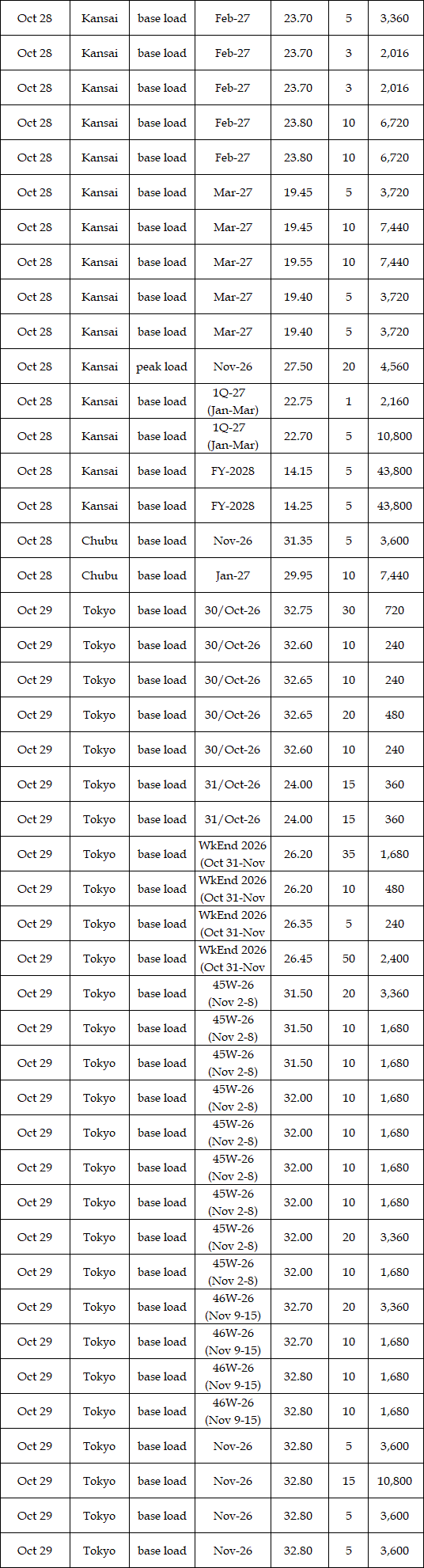
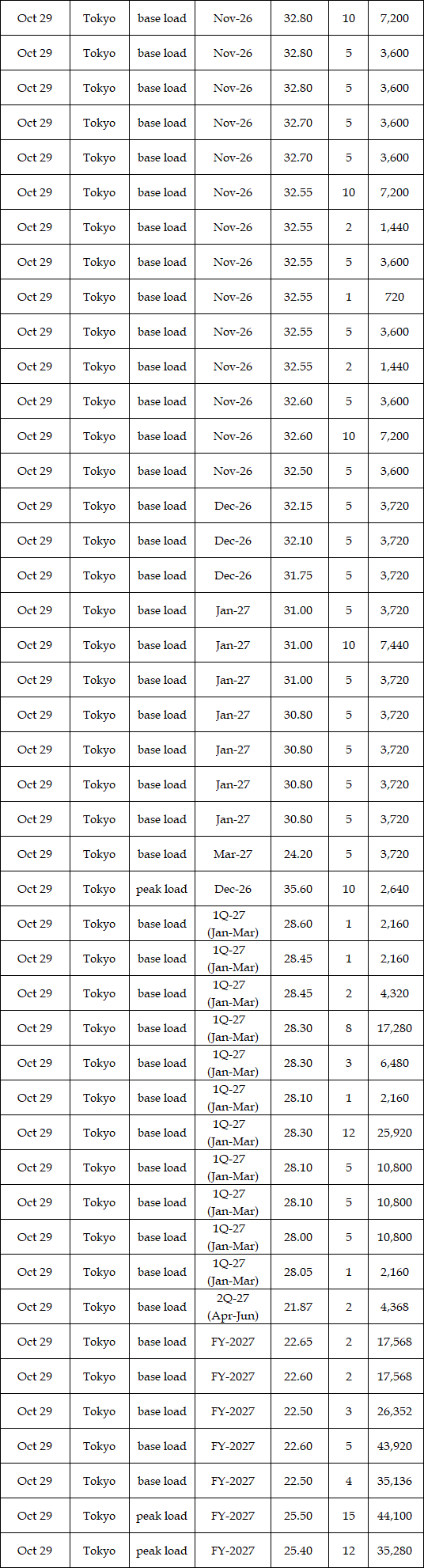
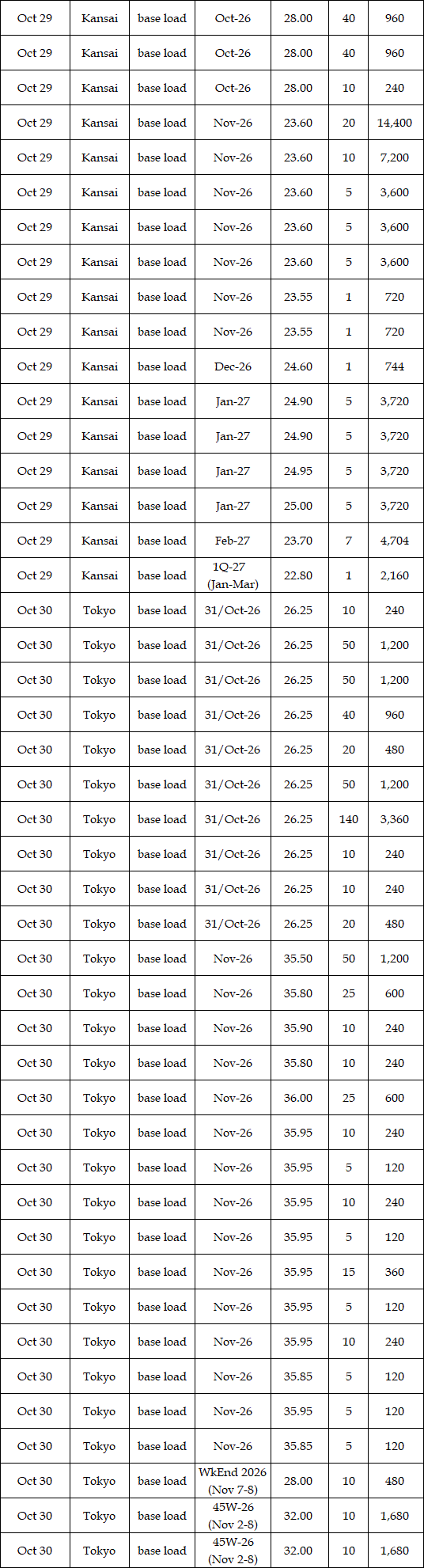
Deals reported on TOCOM (Tokyo Commodity Exchange) during Oct 26-30 were as below.
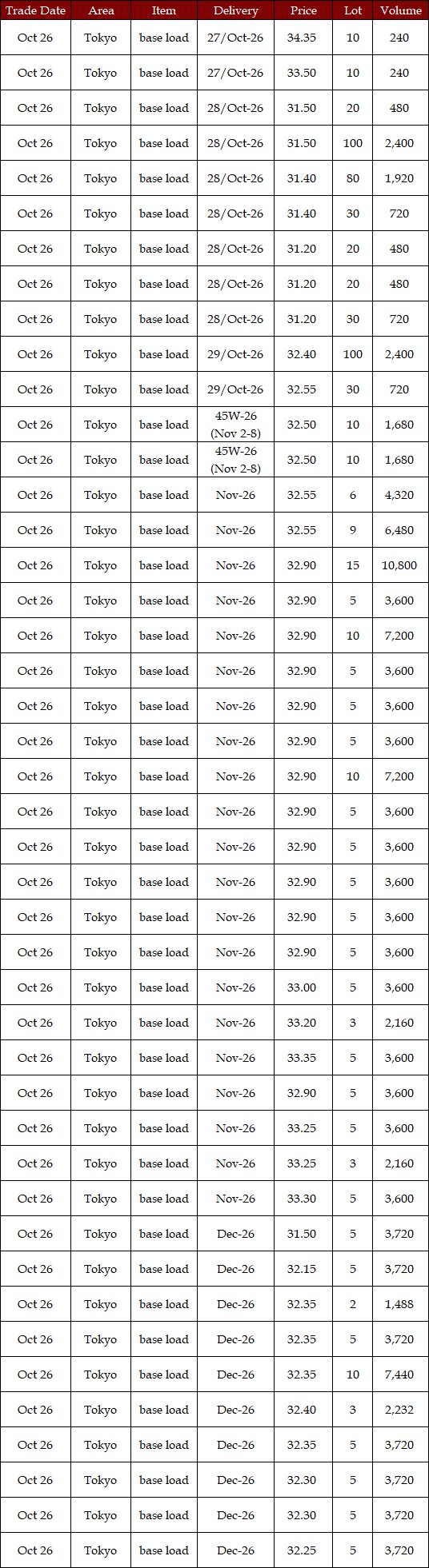
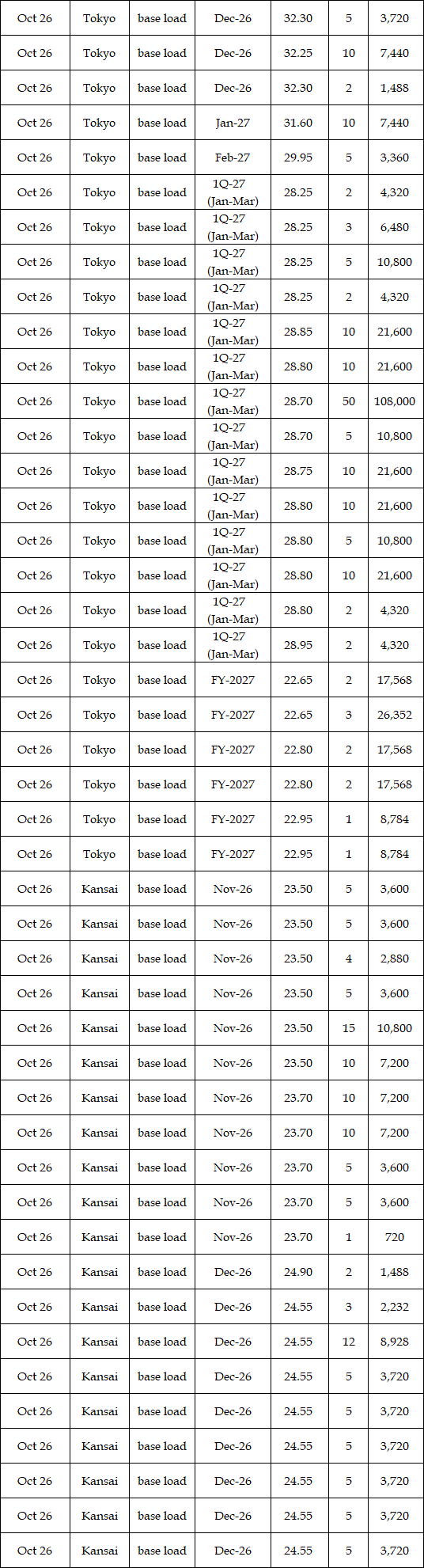
Deals reported on EEX (European Energy Exchange) during Oct 26-30 were as below.
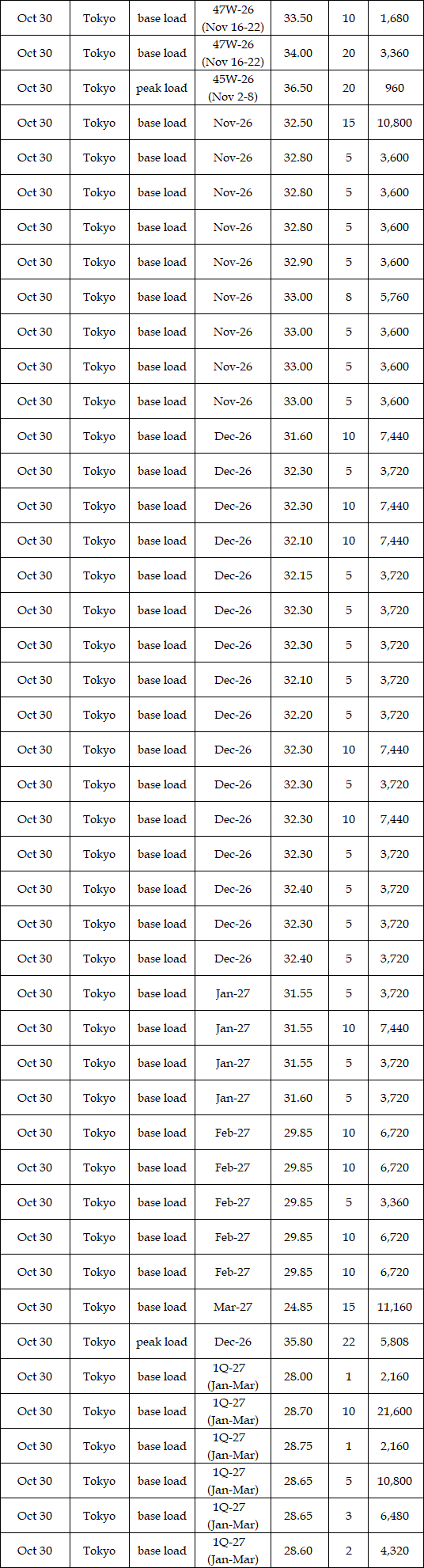
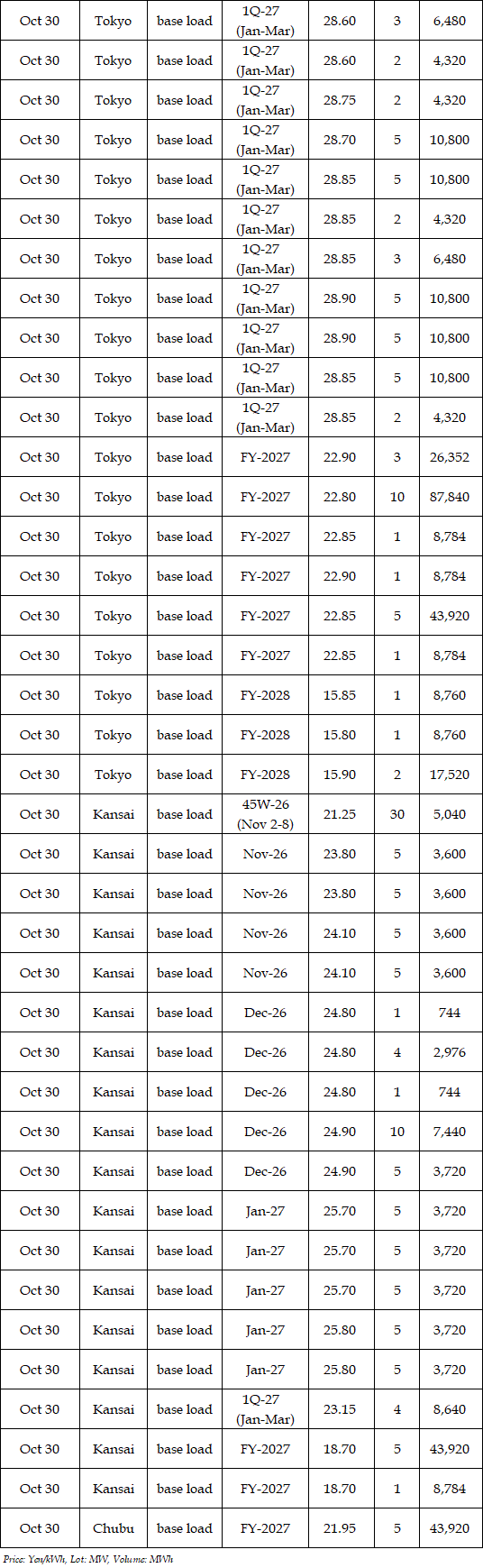
Power spot prices are expected to remain elevated in the first week of Nov, particularly in Tokyo and Chubu. Several large thermal power plants remain offline in both areas, while additional generating units are scheduled to shut down. As a result, available supply capacity is expected to become even more limited, and fluctuations in solar power output depending on weather conditions are likely to play a key role in price formation.
On Nov 2, rain is forecast across a wide area from Tohoku to Kyushu as a low-pressure system and a weather front move through Japan. Lower solar power output could prompt stronger buy bids from daytime hours, potentially pushing up prices.
On Nov 3, however, electricity demand is expected to decline due to the national holiday. In addition, weather conditions are forecast to improve in many parts of eastern and western Japan, likely causing prices to soften temporarily. Improved solar radiation conditions on Nov 4 are also expected to limit price increases during daytime hours.
In the latter half of the week, particularly on Nov 5-6, solar radiation conditions may deteriorate again, mainly in eastern Japan, putting renewed upward pressure on prices. Tokyo's daily average price is expected to hover in the mid-Yen 30s, while Chubu is forecast to trade in the low-Yen 30s and Kansai in the high-Yen 20s to around Yen 30. In particular, prices in Tokyo and Chubu could rise to around Yen 40 during the evening and nighttime hours as solar power output declines.
Regarding the price outlook for the first week of Nov, a market participant said, "We expect base prices to be in the mid-Yen 30s in Tokyo, the low-Yen 30s in Chubu and the mid- to high-Yen 20s in Kansai," according to a power trading official at a new power supplier.
On the supply side, several thermal power units are expected to remain offline, including JERA's Hitachinaka coal-fired power units No. 1 and No. 2 (1,000 MW each) and Sodegaura LNG-fired power unit No. 2 (1,000 MW) in the Tokyo area, as well as JERA's Taketoyo coal-fired power unit No. 5 (1,070 MW) and Hekinan coal-fired power unit No. 4 (1,000 MW) in the Chubu area.
In the Tokyo area, Sodegaura LNG-fired power unit No. 3 (1,000 MW) is also scheduled to shut down during Nov 4-6, raising concerns over tighter supply-demand conditions. In addition, Chugoku Electric Power's Misumi coal-fired power units No. 1 and No. 2 (1,000 MW each) are scheduled to shut down in the Chugoku area, potentially affecting price movements in western Japan.
|
JEPX: System Price (Day Ahead 24 hours)
|
|
Weekday Price
|
26-Oct
|
27-Oct
|
28-Oct
|
29-Oct
|
30-Oct
|
|
24-Hour Ave
|
32.97
|
27.72
|
23.42
|
26.71
|
31.73
|
|
Volume (MWh)
|
1,010,332
|
1,037,944
|
1,050,194
|
1,023,950
|
1,032,784
|
|
(unit: yen per kWh) (date: delivery day)
|
|
|

|
 - Fair & Reliable -

 Post
 Print


