|
The Power spot market declined in both eastern Japan (50Hz) and western Japan (60Hz) during Nov 2-6 from the previous week. Prices in Tokyo and Chubu remained at high levels, particularly in the evening hours when solar power generation declined. Meanwhile, prices in Kansai softened amid lower electricity demand due to the national holiday on Nov 3. Notable price declines were also seen in Hokuriku, Chugoku and Kyushu. Market splitting between areas also had a significant impact on price movements.
By area, Chubu posted the highest weekly average price among the nine areas, exceeding Tokyo. Tokyo also maintained a weekly average price above Yen 30/kWh, although it declined from the previous week. Meanwhile, weekly average prices in Kansai and Hokuriku fell by more than Yen 6/kWh from the previous week, reflecting weakness particularly in western Japan. In Hokkaido, prices reached a high of Yen 50.00/kWh on Nov 2, while lows of Yen 0.01/kWh were observed during daytime hours on Nov 3 in Chugoku, Shikoku and Kyushu.
The difference in the 24-hour average spot prices between Tokyo and Kansai, the two major areas in eastern and western Japan, stood at Yen 10.70/kWh on Nov 2, Yen 16.77 on Nov 3, Yen 13.59 on Nov 4, Yen 12.10 on Nov 5 and Yen 5.59 on Nov 6, with Tokyo consistently higher than Kansai. The price differential widened significantly in the first half of the week before narrowing toward the end of the week.
Fuel market developments in the first week of November were as follows.
The LNG spot price in the Northeast Asian market for December 2026 delivery stood in the low $30s/mmBtu on Nov 6, down more than $2 from the previous weekend (Oct 30). At the beginning of the week, the price rose to the low $35s on Nov 2 amid escalating tensions in the Middle East. However, supply concerns subsequently eased on expectations of progress in diplomatic negotiations between the United States and Iran, pushing the price sharply below $29 on Nov 5. On Nov 6, supply concerns resurfaced following attacks on vessels in the Strait of Hormuz, lifting the price by around $1.50 from the previous day. Japan's LNG inventories for power generation stood at 1.92 million tons as of Nov 1, down 230,000 tons from 2.15 million tons in the previous week. The inventories were below both the year-earlier level of 2.07 million tons at the end of November and the five-year average of 2.13 million tons.
The price of Australian Newcastle thermal coal futures for the November 2026 contract stood at $140.90/ton on Nov 6, down $11.55 from $152.45 on the previous weekend (Oct 30). The sharp declines in international energy prices, including crude oil and LNG, spilled over into the thermal coal market, adding selling pressure. In addition, Chinese buyers remained cautious about purchasing imported coal amid a recovery in domestic coal supply, while sluggish import demand from India also weighed on the market.
In the crude oil market, WTI futures for the December 2026 contract stood at $90.83/barrel on Nov 6, while Brent futures for the January 2027 contract stood at $98.32/barrel. Compared with the previous weekend (Oct 30), WTI fell by $13.29 and Brent by $15.11, both posting substantial declines. Prices remained on a downward trend in the first half of the week amid expectations of a diplomatic resolution between the United States and Iran. The declines accelerated as hopes for easing tensions in the Middle East grew following the results of the U.S. midterm elections. However, supply concerns resurfaced toward the weekend following attacks on tankers in the Strait of Hormuz, helping prices stabilize. On Nov 6, WTI rose by $0.31 from the previous day, while Brent gained $0.03..
The highest spot price during the week was Yen 50.00/kWh, recorded in Tokyo and Hokkaido on Nov 2. Meanwhile, the lowest price was Yen 0.01/kWh, recorded in Chugoku, Shikoku and Kyushu on Nov 3, and in Kyushu on Nov 6.
The weekly averages of 24-hour spot prices, traded volumes, and buy and sell bid volumes by area were as follows.
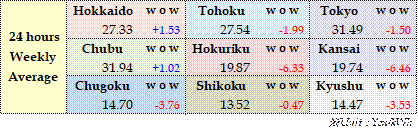

Power demand in the nine areas during Nov 2-6 totaled 10,462.0 GWh, down 0.5% from 10,512.7 GWh in the previous week (Oct 26-30). Demand during the corresponding period of Nov 3-7 last year, adjusted to match the days of the week, totaled 10,643.9 GWh, representing a year-on-year decline of 1.7%.
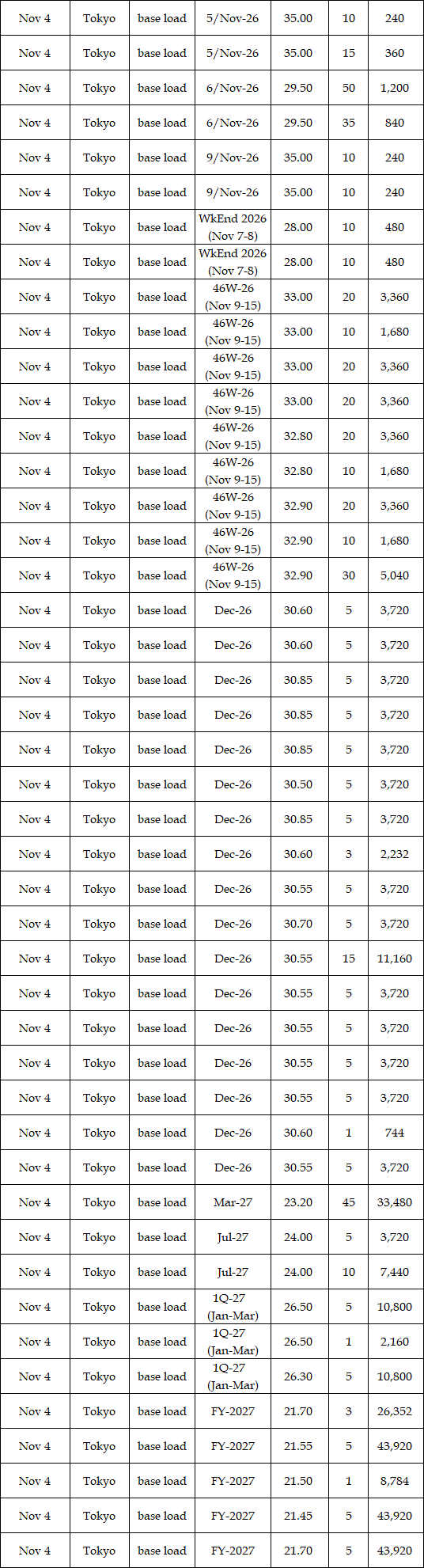
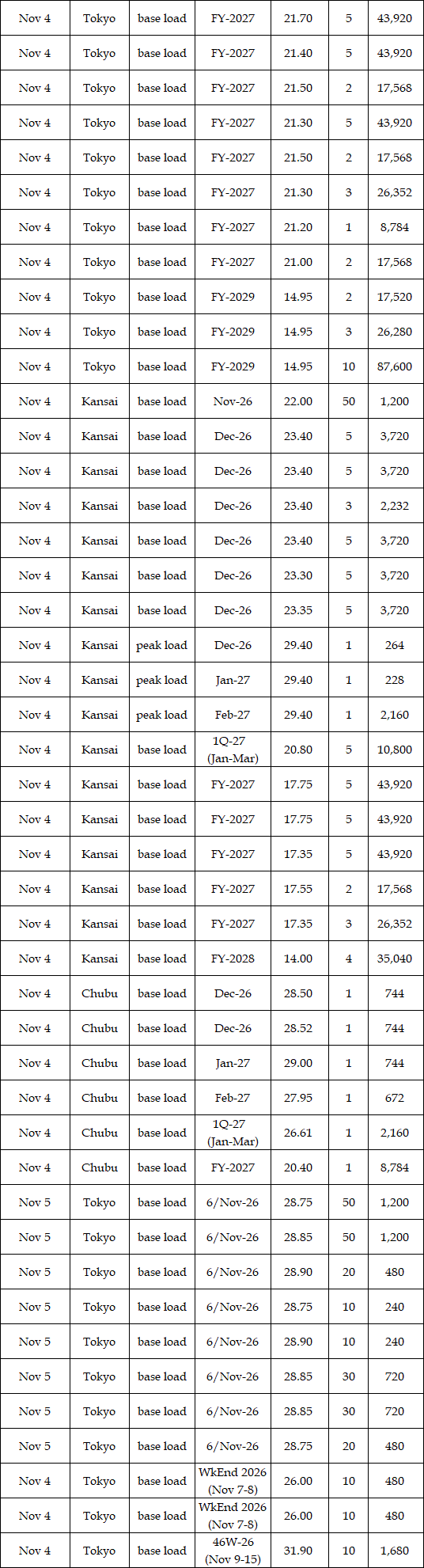
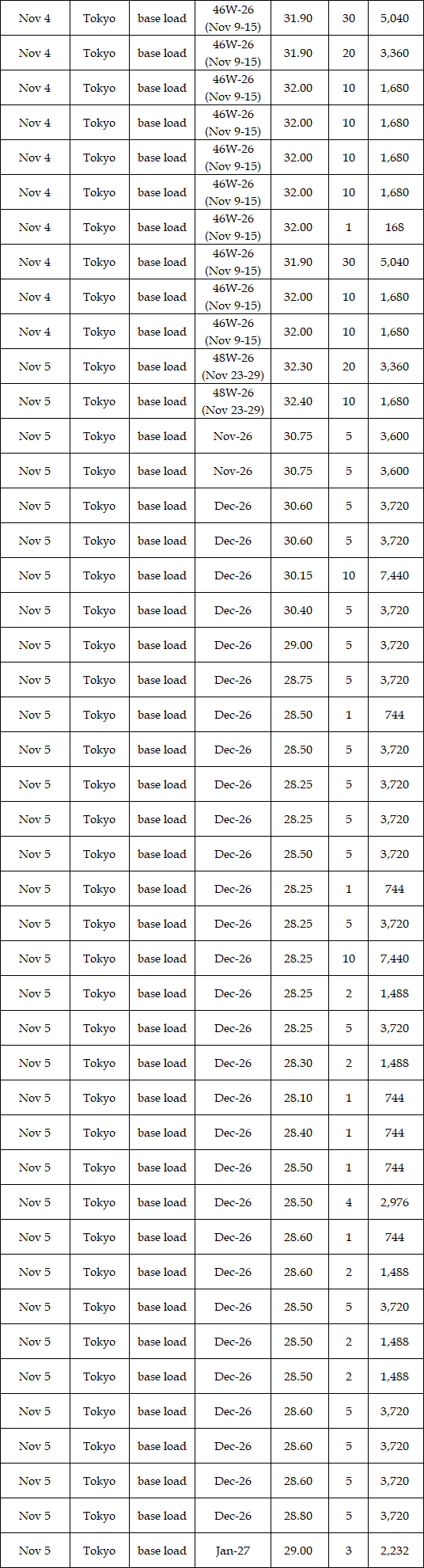
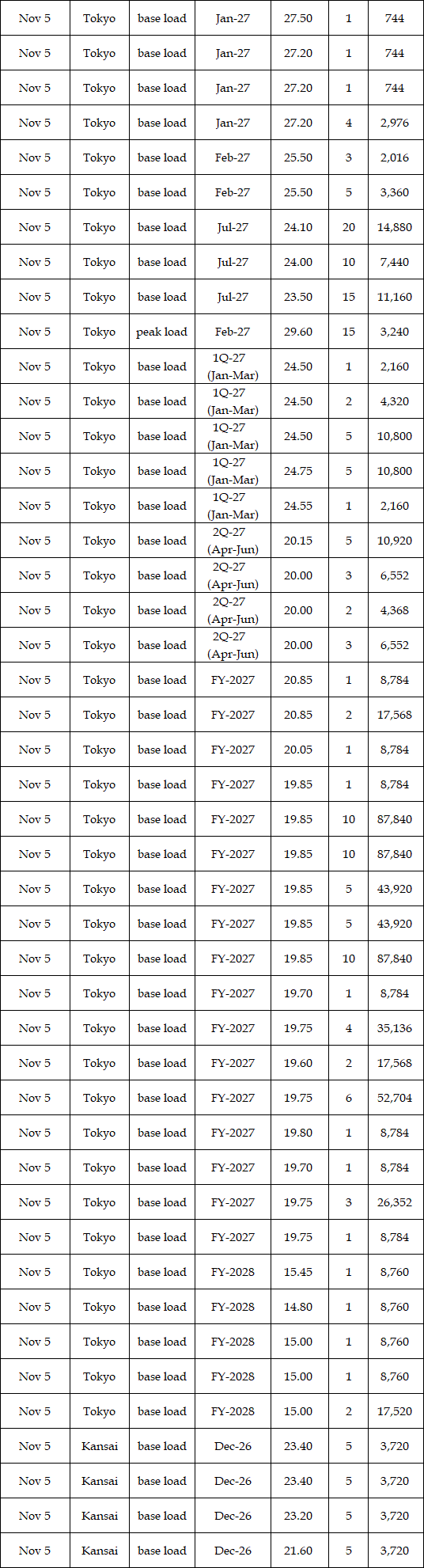
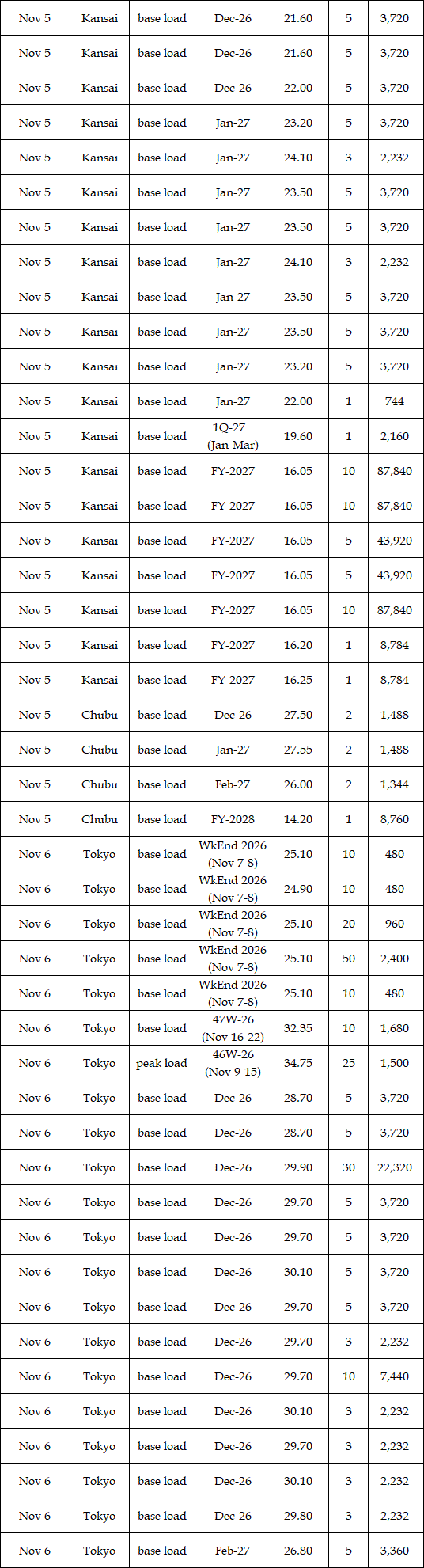
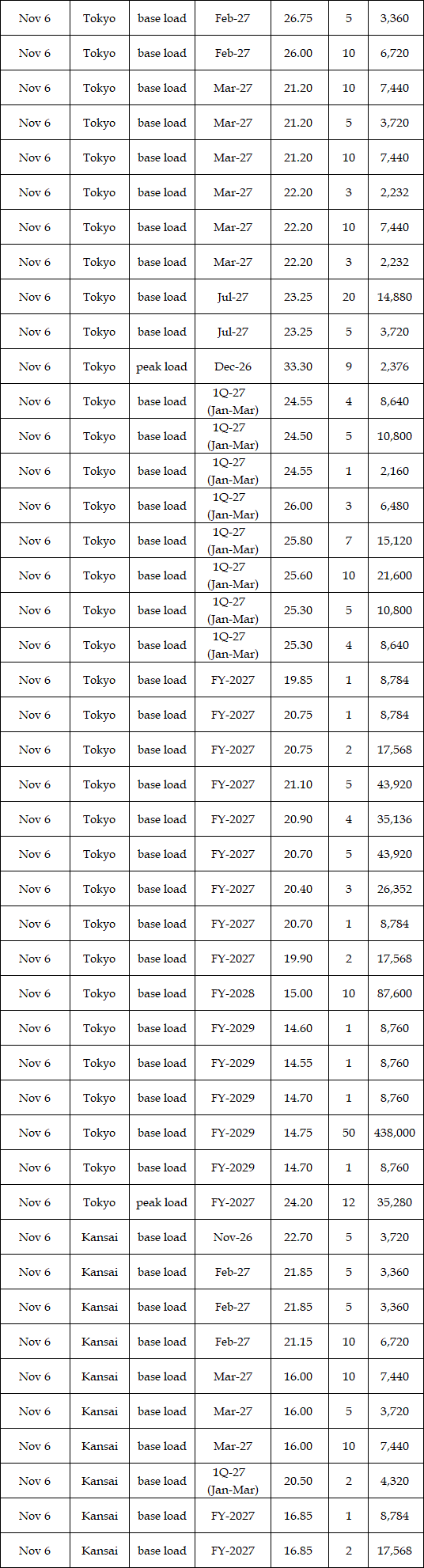
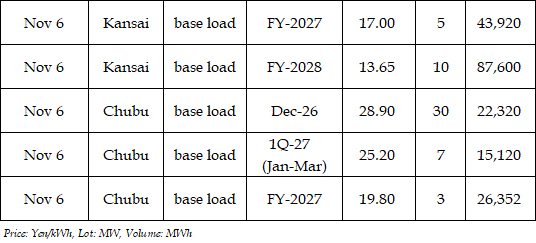
Deals reported on TOCOM (Tokyo Commodity Exchange) during Nov 2-6 were as below.
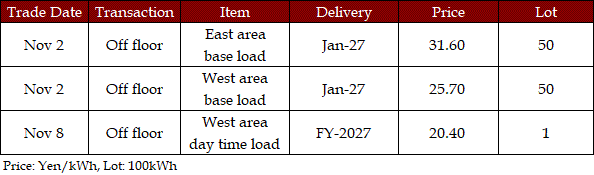
Deals reported on EEX (European Energy Exchange) during Nov 2-6 were as below.
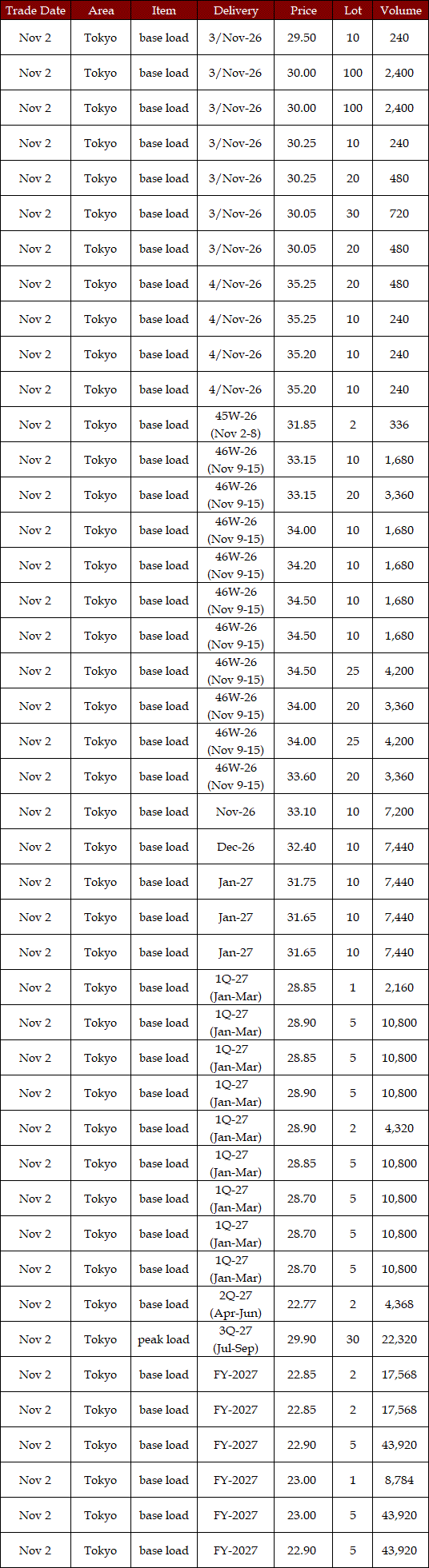
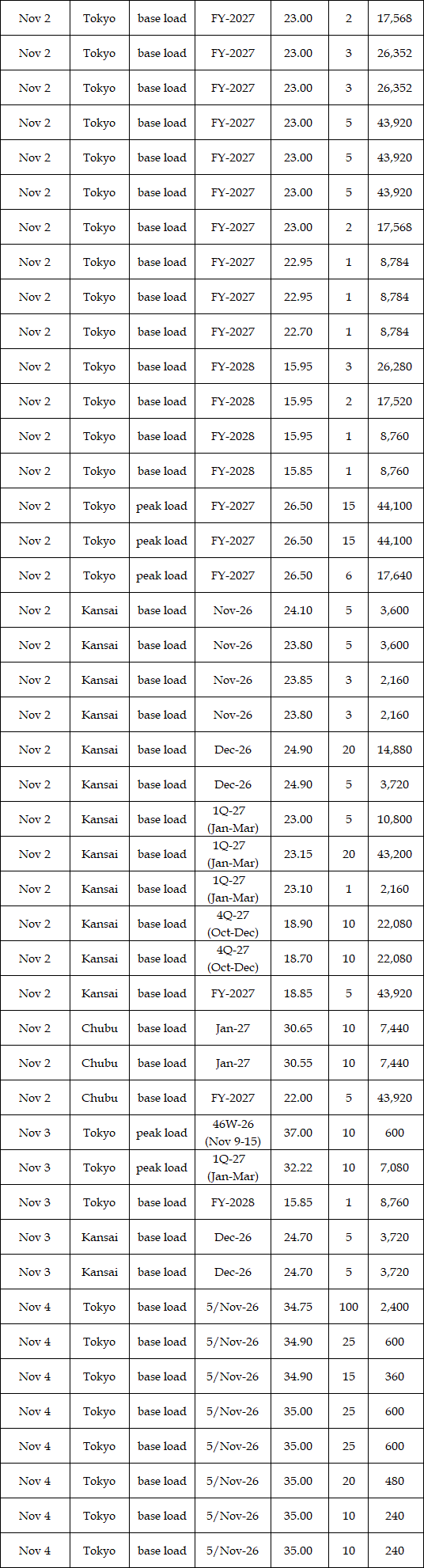
spot prices are expected to remain at high levels in the second week of November, particularly in Tokyo and Chubu. With large thermal power plants remaining offline in both areas, fluctuations in solar power generation are likely to influence price movements. Meanwhile, prices in Kansai, which fell sharply in the previous week, are expected to remain relatively weak compared with eastern Japan.
On the supply side, JERA's Hitachinaka Kyodo coal-fired power plant Unit 1 (rated capacity: 650 MW) in the Tokyo area reduced its output on Nov 6, while JERA's Hekinan coal-fired power plant Unit 5 (1,000 MW) in the Chubu area went offline on the same day. The operating status of these two plants could affect supply availability during the second week. In the Kansai area, Kansai Electric Power's Maizuru coal-fired power plant Unit 2 (900 MW) also reduced its output on Nov 6, and attention is focused on when it will return to normal operation.
Regarding interregional transmission lines, restrictions on operating capacity due to maintenance work at frequency conversion facilities could affect market splitting between eastern and western Japan. The difference in the 24-hour average spot prices between Tokyo and Kansai widened to as much as Yen 16.77/kWh in the previous week. Power transfers between eastern and western Japan are therefore likely to remain an important factor in price formation.
Regarding price movements in the second week, a market participant said, "We expect baseload prices to hover in the low Yen 30s/kWh in Tokyo, the low to mid-Yen 30s in Chubu, and the low Yen 20s in Kansai," according to a power trading official at a new power supplier. In Chubu, prices could exceed those in Tokyo if supply constraints at large thermal power plants persist. Particularly during the evening and nighttime hours, when solar power generation declines, prices in Tokyo and Chubu could rise to around Yen 40/kWh. Meanwhile, Kansai prices are expected to remain relatively weak compared with eastern Japan if sufficient solar power generation is available during daytime hours.
|
JEPX: System Price (Day Ahead 24 hours)
|
|
Weekday Price
|
2-Nov
|
3-Nov
|
4-Nov
|
5-Nov
|
6-Nov
|
|
24-Hour Ave
|
30.09
|
21.37
|
26.60
|
30.81
|
21.29
|
|
Volume (MWh)
|
956,412
|
975,891
|
1,016,661
|
1,042,630
|
1,043,820
|
|
(unit: yen per kWh) (date: delivery day)
|
|
|

|
 - Fair & Reliable -

 Post
 Print


